 The tarka Manual
3. The Bookshop Trail
The Bookshop Trail is a walking and driving route between independent bookshops, from Portree on Skye to Penzance at the end of Cornwall, by way of Wigtown, Scotland's book town, and Hay-on-Wye. Thirty-three shops are on it, in thirty real towns and cities. The shops, their owners, the books and the authors are invented; the places are real. It is the dataset of the Semantechs SPARQL, SHACL and Ontology courses, and this manual borrows their data unchanged, so that what you make here can be queried with the SPARQL course's questions and validated with the SHACL course's shapes.
The dataset is fiction. Any resemblance between a bookshop, publisher, author or book here and a real one is coincidental: names were chosen to sound plausible for their setting. See the courses' NOTICE.
The ontology
The trail's vocabulary is a small OWL 2 DL ontology, reference/01-vocabulary.ttl, with two namespaces:
| Prefix | Namespace | Holds |
|---|---|---|
bs: |
https://example.org/bookshop-trail/schema# |
the schema: classes and properties |
bt: |
https://example.org/bookshop-trail/ |
the things: bt:shop-inkwell, bt:place-wigtown … |
It also uses GeoSPARQL (geo:, sf:) for geometry, WGS84 (wgs84:) for coordinates, SKOS for the genres, and Dublin Core (dct:) for titles. The parts this manual fills are these:
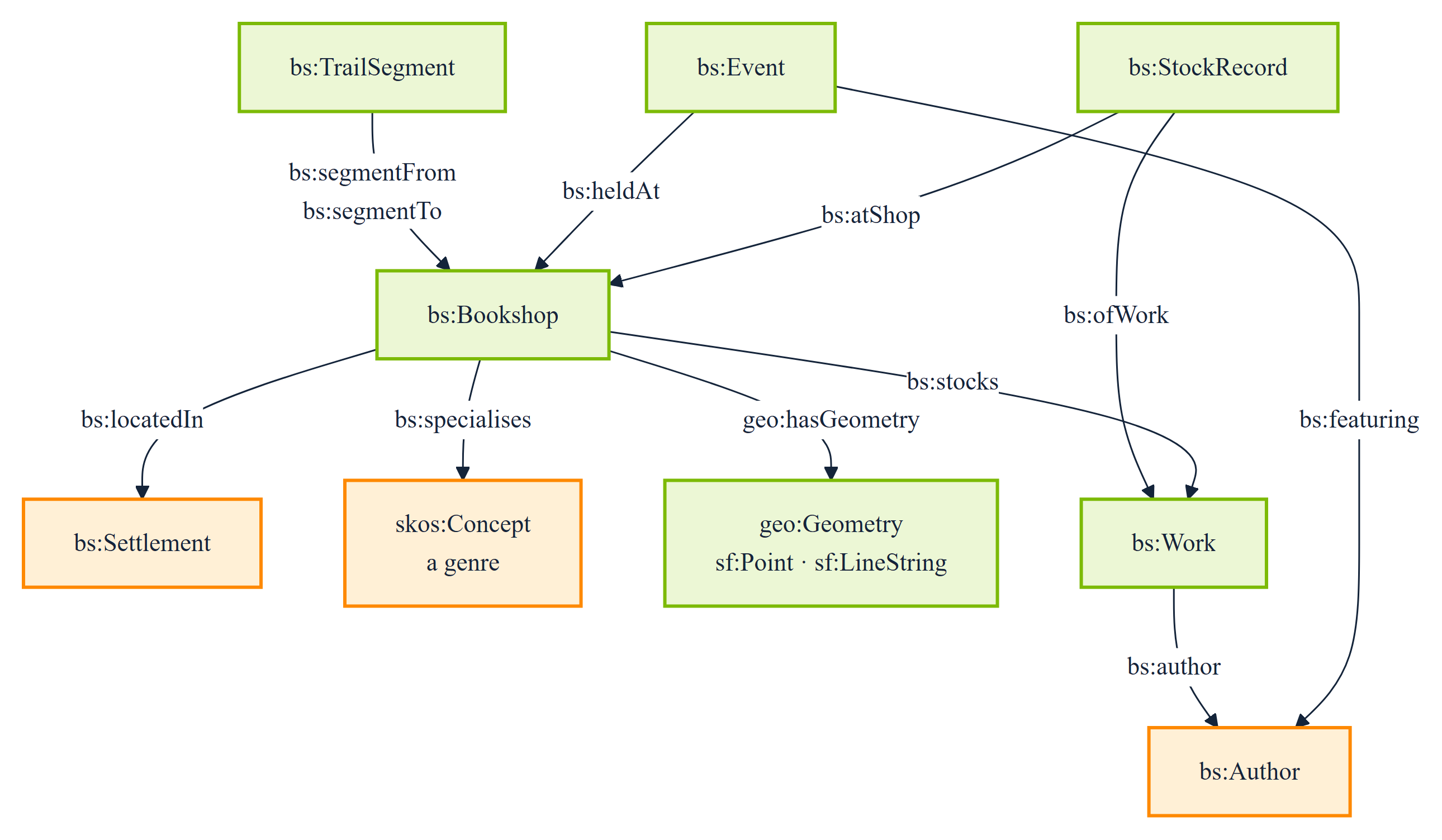
Green are the things this manual makes from spreadsheets; orange are reference data, there already, which the made things point at. A bookshop, as the course data has it:
bt:shop-marginalia
    a                       bs:Bookshop, geo:Feature ;
    rdfs:label              "Marginalia"@en ;
    bs:locatedIn            bt:place-wigtown ;
    bs:founded              "1994"^^xsd:gYear ;
    bs:floorArea            "85.0"^^xsd:decimal ;
    bs:staffCount           "2"^^xsd:integer ;
    bs:specialises          bt:genre-poetry ;
    bs:sellsSecondHand      true ;
    bs:hasCafe              false ;
    wgs84:lat               "54.87287"^^xsd:decimal ;
    wgs84:long              "-4.44087"^^xsd:decimal ;
    geo:hasGeometry         bt:geom-shop-marginalia ;
    geo:hasDefaultGeometry  bt:geom-shop-marginalia .

bt:geom-shop-marginalia
    a          sf:Point, geo:Geometry ;
    geo:asWKT  "<http://www.opengis.net/def/crs/OGC/1.3/CRS84> POINT(-4.44087 54.87287)"^^geo:wktLiteral .
Every value is typed, every link is an IRI, the name has a language, and the point's coordinates are written twice: as WGS84 decimals, for anyone, and as GeoSPARQL WKT, for spatial queries. That is the target. The places, genres and people it points at (bt:place-wigtown, bt:genre-poetry) are reference data: they are not made from the spreadsheets, but they must exist for the links to mean anything, and the validation chapters load them beside tarka's output.
The committee's spreadsheets
The trail's committee does not keep RDF. It keeps five spreadsheets, the way people keep spreadsheets, and these are tarka's input, in data/:
| File | Rows | One row is |
|---|---|---|
bookshops.csv |
33 | a shop: its name, town, details, coordinates, and the titles it stocks |
events.csv |
59 | a reading, signing, workshop or book club at a shop |
works.csv |
74 | a book: title, author, publisher, year, price, series, translation |
stock.csv |
95 | how many copies of a book a shop has, and at what price |
segments.csv |
33 | a stretch of the trail from one shop to another, with a waypoint between |
The first rows of bookshops.csv show the conventions:
shop,name,town,founded,floor_area,staff,specialism,second_hand,cafe,website,lat,long,stocks
bookbarrow,Bookbarrow,keswick,1990,80.0,3,mountaineering,yes,no,https://example.org/shops/bookbarrow,54.60668,-3.13089,scree;the-tarn
bookwyrm,The Bookwyrm,york,2013,120.0,5,fantasy,no,yes,https://example.org/shops/bookwyrm,53.95521,-1.09041,the-dark-sea;the-leat;y-mor-tywyll
None of this is RDF, and all of it is reasonable:
- Short names, not IRIs. A shop is
bookbarrow, a townkeswick, a genremountaineering. The mapping turns them intobt:shop-bookbarrow,bt:place-keswickandbt:genre-mountaineering. - yes and no, not
trueandfalse. - A list in one cell: the titles a shop stocks, separated by semicolons.
- Empty cells: six shops have no website.
events.csv writes dates the British way, 06/09/2025, and prices with a pound sign, £28.00. works.csv has columns that are usually empty (series, translations) and gives each title's language. Each spreadsheet is a chapter's worth of transformation.
Where did they come from? tools/make-spreadsheets.py wrote them from the course data, in the committee's conventions. That makes this manual's best test possible: map the spreadsheets back to RDF, and the result must be the course's graph, triple for triple. Chapter 11 shows how that is checked, and it holds for every mapping in the manual.
Prepared tables
OTTR templates compute nothing (Part III explains why that is a strength). A table for them holds values as they should come out: shop:bookbarrow rather than bookbarrow, a WKT literal rather than two coordinates. python/prepare.py makes such tables from the spreadsheets with Polars, and writes them to data/prepared/:
| File | One row is |
|---|---|
bookshops.csv |
a shop, with prefixed names, its point as WKT, and its titles as prefixed names |
segments.csv |
a segment, joined to the shops at both ends for its label and its line |
shop-stock.csv |
a shop's stock as four parallel lists, joined with ; |
shop-stock.parquet |
the same, with real list columns and typed values: integers, and decimals with two places |
Chapter 9 walks through the script. Until then, take the prepared tables as given.
A faulty spreadsheet
data/faulty/bookshops.csv is bookshops.csv with five mistakes of the kind spreadsheets collect: a town misspelt, a year written "c.1972", a shop with no staff, a website without https://, and a "Yes" where the column says "yes". Chapter 10 finds every one, and shows which tool finds which.