 The tarka Manual
14. A pipeline
Every chapter so far has run one step by hand. In production the steps run together, on every change, and each is a gate: if it fails, the graph does not move on. This chapter puts the trail into a pipeline, says what each stage protects against, and ends with the properties that make tarka safe to automate. The stages run in the order of their numbers, left to right:
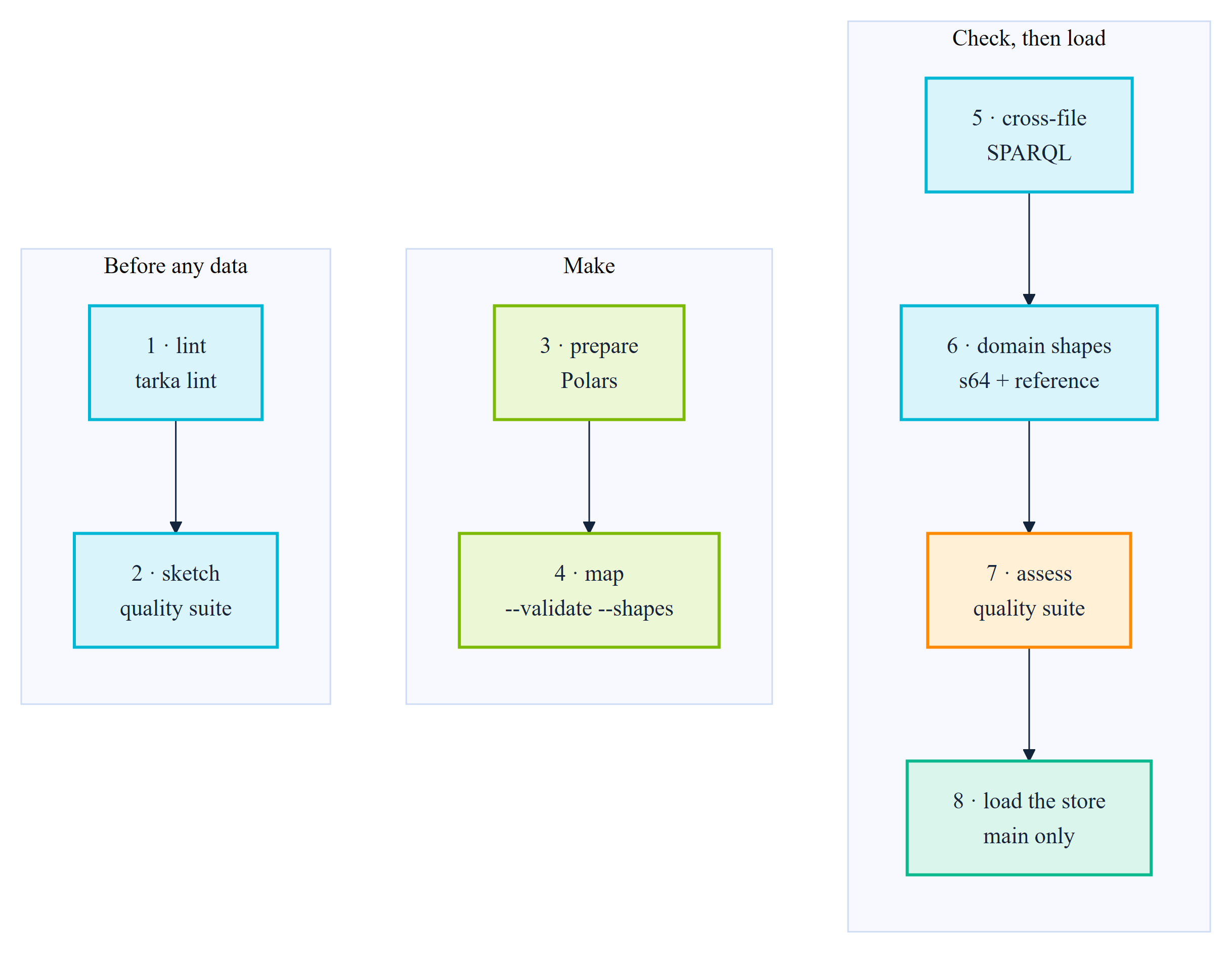
The stages
| Stage | Runs | Stops the pipeline when | Protects against |
|---|---|---|---|
| 1. Lint | tarka lint -l ottr/ --deny-warnings |
a template library has an error or a warning | a template that cannot be right, before it makes anything |
| 2. Sketch | ontology-quality-suite sketch |
(reported) | a mapping that uses terms the ontology does not declare, or uses them wrongly |
| 3. Prepare | python python/prepare.py |
the script fails | tables OTTR cannot read |
| 4. Map | tarka run, tarka bottr, with --validate and --shapes |
a row left out (status 1), output that breaks a shape (status 3) | values that do not fit their mapping, or the project's own rules |
| 5. Cross-file | tools/sparql.py sparql/cross-file-checks.rq … --expect-none |
any row | files that are each right and disagree |
| 6. Domain shapes | python/validate.py (s64, in HOLOS, with the reference data) |
any violation | output that is wrong for the trail: unknown towns, impossible values |
| 7. Assess | ontology-quality-suite data |
(reported) | everything else the suite's registry knows |
| 8. Load | the validated files, into the store | on main only |
a store holding anything that did not pass |
Stages 2 and 7 report and do not gate, here, because the suite's two false positives (Chapter 12) would stop every run; their reports go with the run's artefacts, and a reviewer reads them. Gate on them with --fail-on Violation once the findings you accept are scoped out.
As a workflow
examples/bookshop-trail/pipeline/trail.yml is the whole of it as a GitHub Actions workflow. The heart:
      - name: Lint the templates
        run: tarka lint -l ottr/ --deny-warnings

      - name: Prepare the tables
        run: python python/prepare.py

      - name: Map
        run: |
          tarka run -q tarql/bookshops.rq -i data/bookshops.csv --validate --shapes shapes/trail-extra.ttl -o out/bookshops.ttl
          tarka run -q tarql/stocks.rq -i data/bookshops.csv -o out/stocks.ttl
          tarka run -q tarql/events.rq -i data/events.csv --shapes shapes/trail-extra.ttl -o out/events.ttl
          tarka run -q tarql/works.rq -i data/works.csv -o out/works.ttl
          tarka run -q tarql/stock.rq -i data/stock.csv --shapes shapes/trail-extra.ttl -o out/stock.ttl
          tarka bottr -l ottr/ bottr/segments.bottr.ttl -o out/segments.ttl
          tarka bottr -l ottr/ bottr/connections.bottr.ttl -o out/connections.ttl

      - name: Check the set of files
        run: python tools/sparql.py sparql/cross-file-checks.rq out/*.ttl --expect-none

      - name: Validate with the SHACL course's shapes
        run: python python/validate.py out/bookshops.ttl out/stocks.ttl out/stock.ttl out/events.ttl out/works.ttl out/segments.ttl out/connections.ttl
and the load, which sends exactly the files that passed, one graph per source, each replaced so that a reload is idempotent:
      - name: Load the store
        if: github.ref == 'refs/heads/main'
        run: |
          for f in bookshops stocks stock events works segments connections; do
            curl -sf -X PUT -H "Content-Type: text/turtle" -H "$AUTH" --data-binary "@out/$f.ttl" \
              "$STORE?graph=https://example.org/bookshop-trail/graph/$f"
          done
Where no validation stands between mapping and store, tarka run … --post $STORE --replace --graph … loads as it maps, and saves the file (Chapter 13).
The titles stocked come from the shops' own rows (bookshops.csv), and the stock records from stock.csv: two sources, so stage 5's first check, stocked, but no stock record, compares two things that could disagree. Mapping both from one table would make the check pass by construction, and tell you nothing.
What makes tarka safe to automate
- Exit status means something. 0, complete and conforming; 1, an error or something left out; 2, a wrong command line; 3, written but not conforming. A pipeline needs no log parsing.
- A file is all or nothing.
-owrites beside the file and moves it into place, so a run that fails leaves the last good file, not half of a new one. A load that fails sends the store nothing. - The same input gives the same bytes. Output order is the mapping's, blank node labels are stable, typed values are canonical (or, through bOTTR, as written, every time). A diff between two runs' files is a real change, and the round trip of Chapter 11 works between this month's graph and last month's.
- Errors are messages. A query tarka cannot evaluate is refused before any row is read; a bad row is named, with its column and its value.
The mappings are code
Treat them so. The queries, templates, maps and shapes live in source control beside the data's schema; a change to one is a pull request; the pull request runs the pipeline on a sample (--test 100) and the sketch, and the reviewer reads the sketch's findings and the diff of the output. The manual's own check.py is this in miniature: every example, run in order, each result checked, and if the chapter and the script disagree, the chapter is the bug.
SemOps Manual, Chapter 9 builds continuous integration for a semantic practice around exactly these properties, Chapter 10 puts tarka in its ingest stage, and Chapter 12 carries the graph on through release and change.
The end of the trail
From five spreadsheets, kept the way people keep spreadsheets, to the courses' graph, triple for triple, by three routes, every one checked: by shapes as it was written, by the domain's rules with the data they refer to, by queries across files, by a registry of checks, and against the graph it was meant to be. That is the whole of tarka, and the whole of the job: making RDF is the easy part; knowing it is right is the work.