 The SemOps Manual
10. Ingest and transform
Part III — The practice · SemOps stage 6 · Operating-model layer 4
Stories answered here As a data engineer, I want to know a transformation is wrong before I run it over four million rows. As a data steward, I want to know whether a finding is our problem or an upstream vocabulary's.
SemOps layer 4 asks for ETL orchestration, incremental ingestion, data-quality checks, error handling and provenance capture. This toolchain covers the quality and correctness half thoroughly and the orchestration half not at all — there is no scheduler here, and Airflow, Argo or Prefect remain the right answers for that (Chapter 14).
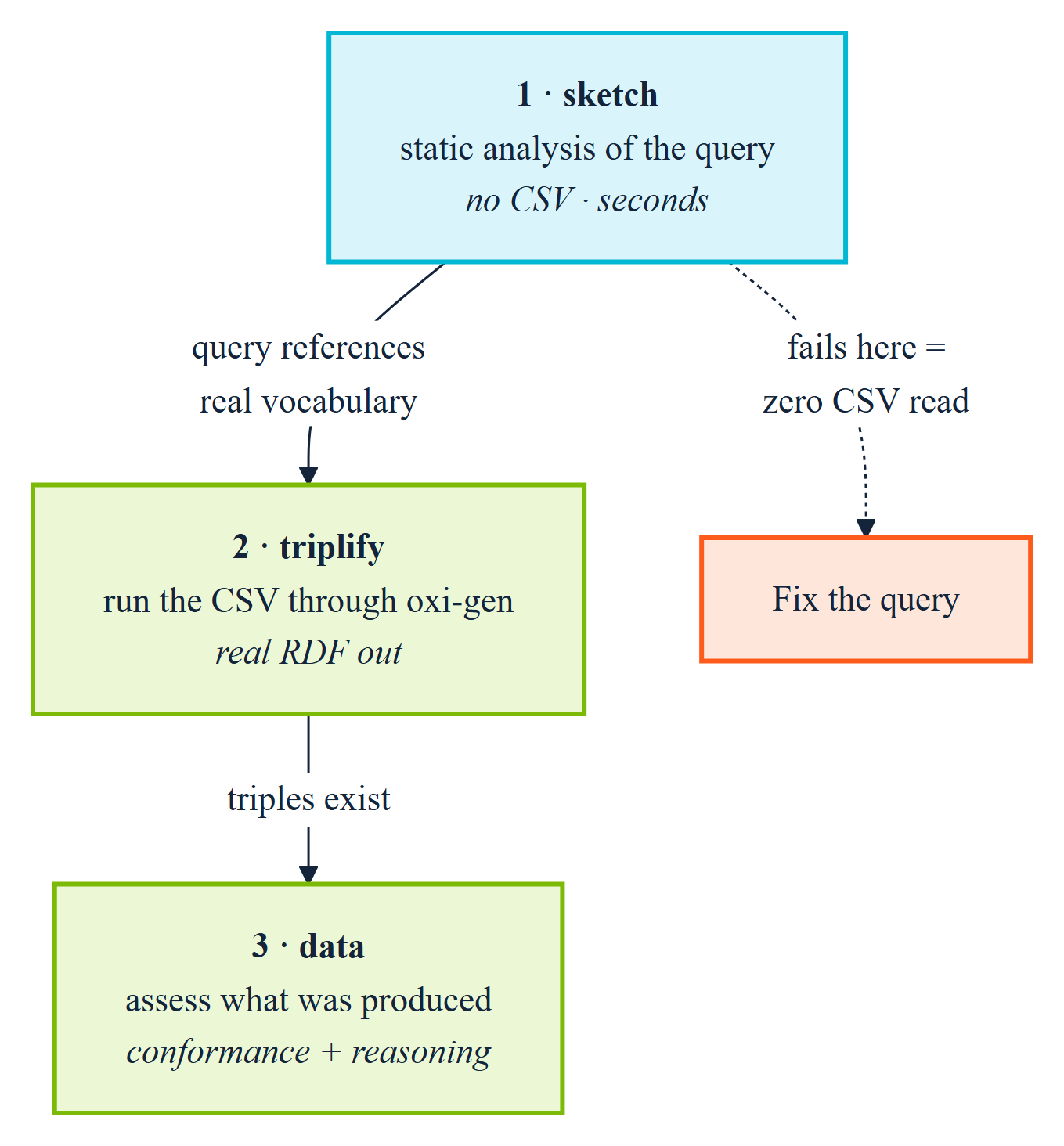
What it does provide is a three-stage pipeline arranged on one principle: cheapest check first.
10.1 Before the pipeline: drafting from a CSV
Most real ingestion starts with a CSV somebody emailed you, and the first question is what the ontology should even look like.
The extension's Infer Ontology + Query from CSV profiles a raw CSV — sniffing types and cardinality — and drafts both a starter ontology fragment and a CONSTRUCT query wired to it. It is a starting point, not an answer: an inferred model reflects the shape of one extract, not the shape of the domain, and Chapter 2's exemplar-driven expert will find its boundary cases in minutes.
The Query Workbench is the more durable tool. It gives a live, debounced preview of the transformation's real triplified output against sample rows — using Oxigraph, with TARQL semantics reproduced via a standard SPARQL VALUES injection — alongside a static sketch of the CONSTRUCT template and conformance warnings against the ontology.
The point is the loop length. Discovering a wrong BIND after a full pipeline run is a twenty-minute round trip; discovering it in a live preview is immediate, and immediate feedback is what makes people willing to iterate on a transformation rather than accepting the first one that runs without erroring.
10.2 Stage 1: sketch — before any CSV is read
sketch is pure static analysis of the query text against the ontology. It answers "does this transformation even reference vocabulary the ontology declares?" without touching a single row of data.
python -m ontology_suite sketch \
  --queries examples/acme_robotics \
  --ontology examples/acme_robotics/acme-org-v1.ttl \
  --import-dir examples/acme_robotics \
  --out-dir out/sketch
Findings: 38 total (0 Violation, 0 Warning, 38 Info)
Sketch used 1 query file(s); 8 triples, 7 entities.The summary line is the useful part: 8 triples, 7 entities from 1 query file. That is the shape the transformation will produce, derived from the query alone. A reviewer who expected fifteen predicates and sees eight has found a bug before any data moved.
--queries takes either a file or a directory. It used to insist on a directory, failing on a file path with No files matching '*.sparql,*.rq,…' — if you meet that, you are on an older build (Chapter 14 §14.6). Use --file-pattern to narrow or widen the glob when pointing at a directory.
Four extensions are recognised as transformation queries: .sparql, .rq, .tarql and .tq. The pairing with a CSV is by filename convention, which is the point worth drawing out — the mapping is a query in source control, diffable in a pull request and testable on its own, rather than transformation code buried in a script. That is what makes the ingest layer reviewable by someone who did not write it.
.tqand.tarqlare the more recently added of the four and are lightly exercised. If a query is not being picked up, check the extension before anything else, and--file-patternwill narrow or widen the glob.
The query itself is now checked
Five checks in the registry look at the transformation rather than the graph it produces, and they run in this stage:
| Check | What it catches |
|---|---|
TQL-001 |
One target variable bound by structurally different expressions in different query files |
TQL-002 |
A ?x_IRI variable used in the CONSTRUCT but never bound |
TQL-003 |
A CONSTRUCT variable neither bound nor appearing in the WHERE |
TQL-004 |
A ?x_IRI bound to CONCAT with nothing turning the result into an IRI |
TQL-005 |
A ?x_DT variable never given a datatype with STRDT() |
TQL-004 is the one that repays reading twice. SPARQL's CONCAT returns a string, and TARQL does not coerce it, so a variable named ?person_IRI that is built by CONCAT and never wrapped in IRI() silently produces string literals where the model says there should be IRIs. The data loads, the counts look right, and every join against those subjects finds nothing.
Two of these rest on a naming convention — ?x_IRI for a constructed IRI, ?x_DT for a value given an explicit datatype. That is worth adopting even if you never run the checks: it puts the intent in the variable name, where a reviewer sees it.
The stage also writes bind-facts.ttl beside the report — a node per BIND carrying its target, expression, skeleton, file and line, plus one per CONSTRUCT variable recording whether it is bound. The bound ones are included deliberately, so "what does this query actually bind?" is answerable rather than only "where are the gaps?" It is a small instance of a good habit: the transformation's own structure has been turned into a graph, so it can be queried with the same tools as everything else.
Because sketch needs no CSV, no oxi-gen binary and no data access, it is the right gate for a pull request that changes a transformation query — it runs in seconds and needs no production data in CI.
10.3 Stage 2: triplify — produce real RDF
python -m ontology_suite triplify \
  --csv-dir examples/acme_robotics \
  --queries examples/acme_robotics \
  --out-dir out/triplify
Triplified 1 file(s) into out/triplify
- out/triplify/employees.ttlThis shells out to the real oxi-gen binary (auto-discovered, or passed with --oxi-gen-bin). The output is genuine RDF:
@prefix acme: <https://acme.example.org/ns/> .
@prefix foaf: <http://xmlns.com/foaf/0.1/> .

<https://acme.example.org/data/employee/E004> a acme:Employee , acme:Engineer ;
    foaf:mbox <mailto:margaret.hamilton@acme.example.org> ;
    foaf:name "Margaret Hamilton" ;
    acme:hasEmployeeId "E004" ;
    acme:hasRole "Test Engineer" ;
    acme:hasSkill "Automation" ;
    acme:worksIn <https://acme.example.org/data/department/QA> .
Useful flags in practice: --test N triplifies only the first N rows (fast iteration on a large file), --delimiter/--tab for non-comma input, --no-header-row, --dedup N, and --ntriples for line-oriented output that diffs and streams well.
--test deserves a habit: run it before every full run. It costs seconds and it catches the class of error where a transformation is syntactically fine and semantically wrong.
10.4 Stage 3: data — assess what was actually produced
python -m ontology_suite data out/triplify/employees.ttl \
  --ontology examples/acme_robotics/acme-org-v1.ttl \
  --import-dir examples/acme_robotics \
  --engine sparql --out-dir out/data --fail-on never
Findings: 550 total (68 Violation, 363 Warning, 119 Info)Five hundred and fifty, and the same lesson as Chapter 9 applies identically. Scope it:
python -m ontology_suite data out/triplify/employees.ttl \
  --ontology examples/acme_robotics/acme-org-v1.ttl \
  --import-dir examples/acme_robotics \
  --engine sparql \
  --own-namespace "https://acme.example.org/" \
  --out-dir out/data_own --fail-on never
Findings: 54 total (12 Violation, 40 Warning, 2 Info)54 or 55, depending on one thing. The scoped data run returns 54 findings when the external DL reasoner fails to start and 55 when it succeeds — the extra one is
REA-021, HermiT's unsatisfiability finding onacme:Contractor, discussed below. Everything else is identical. This is the only variation in the scoped figures anywhere in the manual, it has a known cause, and the difference is visible in the report: ifREA-021is present you got the reasoner, and ifREA-022is present you did not.
Note the namespace here is https://acme.example.org/ — one level up from the ontology's https://acme.example.org/ns/ — because the data individuals live under https://acme.example.org/data/. The filter is a literal IRI-prefix match, so it must cover both the schema terms and the instance IRIs. Choosing that prefix deliberately is part of designing your IRI scheme, and it is much easier to get right at the start than to retrofit.
What those findings actually say
Scoped, the findings become readable, and they fall into three genuinely different kinds — a distinction worth teaching a team explicitly, because treating them identically is what makes people ignore all three:
Real data defects. The largest group:
STR-006 [Violation]  Untyped object of a triple
   Object .../data/department/ENG of triple (.../employee/E001 acme:worksIn)
   is never given a type

DAT-002 [Warning]  Dangling IRI reference
   Reference target .../data/department/ENG is never used as a subject
Both are correct and both point at the same real gap: the transformation produces employees who worksIn a department IRI, but nothing in the pipeline ever produces the departments themselves. Every employee references a resource that does not exist in the graph. That is exactly the class of defect this stage exists to catch, and it is invisible in the CSV, invisible in the query text, and obvious the moment you assess the output.
Inherited schema problems. LOG-001, QUA-001 on acme:hasSkill, STR-003 and STY-002 on acme:reports_to — the same ontology findings from Chapter 8, reappearing because data evaluates the ontology alongside the data. Not new information; not noise either. If the schema is broken, the data built on it inherits the problem.
Coverage signals, not errors.
CNF-005 [Info]  Ontology class never populated
   Class acme:Contractor is declared in the ontology but the data graph
   never uses it as an rdf:type
Nothing is wrong. acme:Contractor is declared and this extract contains no contractors. As an Info this is right, and it is genuinely useful: a class that is never populated across any extract is either dead vocabulary or a transformation that quietly stopped emitting it. Worth reviewing periodically; never worth failing a build on.
The reasoner, when it turns up
When the DL reasoner starts, the scoped run carries one extra finding:
REA-021 [Violation]  Class found unsatisfiable by an external DL reasoner
   acme:Contractor is unsatisfiable (equivalent to owl:Nothing)
   according to the hermit reasoner
HermiT has independently confirmed what the pattern-based LOG-001 found by a completely different route — a rule-based closure and a real description-logic reasoner agreeing on the same contradiction. Two independent confirmations of one deliberate flaw is the ideal outcome, and it is the reason the suite runs both rather than choosing.
When it does not start, you get REA-022 instead, and the run reports 36 rather than 37. This is not a difference between the ontology and data commands, though an earlier draft of this manual presented it that way on the strength of two runs. Running the ontology command three times in one session settles it: the first invocation produced LOG-001 + REA-020 + REA-021 with HermiT working, and the second and third produced LOG-001 + REA-022 with it failing. Same command, same fixture, same session, different outcomes.
The suite's own ACME_ROBOTICS_WALKTHROUGH.md names this directly — HermiT is "occasionally environment-flaky in ways unrelated to this fixture (a transient internal error rather than a real unsatisfiability finding)" — so it is known instability in the owlready2/HermiT bridge that can hit any invocation, not a mystery about code paths.
That is exactly Chapter 4's point, and the correction is part of it: a research-lineage component's failure modes are yours to discover, two data points are not a pattern, and what makes the dependency safe to hold is that the wrapper says clearly which checks did not run instead of reporting success.
Large graphs
For a data graph too large to reason over in full, --sample N caps the reasoning pass to a bounded-description sample of N named subjects while still running the full (cheap) registry over everything:
python -m ontology_suite data out/triplify/employees.ttl \
  --ontology examples/acme_robotics/acme-org-v1.ttl \
  --sample 5000 --engine sparql --out-dir out/data
This is the Level-4 "operations at scale" adaptation in Chapter 6: reasoning is the expensive stage, and sampling it is what keeps a nightly job inside its window.
10.5 Whose problem is it?
This is the question a data steward asks most often, and the three-way split above is the answer in general form:
| Finding is about | Owner | Action |
|---|---|---|
| Your instance data | Data engineer | Fix the transformation or the source |
| Your ontology | Ontology owner | Fix the schema; it will recur on every extract |
| An upstream vocabulary | Nobody here | Filter it out of the gate; audit periodically |
Coverage (CNF-005) |
Data steward | Review, do not gate |
The most expensive mistake is treating row 3 as row 1 — engineers spending days proving that a finding against someone else's vocabulary is not their fault. --own-namespace exists to make that impossible.
10.6 What is not here
Stated plainly, because SemOps layer 4 asks for it and this toolchain does not provide it:
- Orchestration and scheduling. No DAG, no retry logic, no backfill. Airflow, Argo Workflows or Prefect, calling these commands as steps.
- Incremental ingestion. Every run is a full pass. Incrementality is your pipeline's job.
- Streaming. This is batch. Kafka-shaped ingestion is out of scope.
- Provenance capture. The tooling does not stamp provenance onto the output. Named graphs at load time are the practical answer (Chapter 13), and it is far easier to do at ingest than to retrofit.
That last one is worth planning before your first production load, not after. Chapter 3 explains why it becomes urgent the moment data crosses an organisational boundary.
10.7 Maturity checkpoint
Running sketch as a query-PR gate, triplify with --test before full runs, and data --own-namespace on the output gives you Level 3's data-quality dimension: quality checks automated, regressions caught early.
Level 3 also expects orchestrated ETL and ingestion monitoring, which are not here. Level 4 expects continuous ingestion with error handling and retry logic — also not here. Those are real gaps, not omissions from this chapter; see Chapter 14.