 The SemOps Manual
12. Release and change
Part III — The practice · SemOps stages 1 and 4 · Operating-model layers 1 and 2
Stories answered here As a domain steward, I need to know whether this release is breaking, and what breaks, before I approve it. As the person who has to fix the fallout, I want the mechanical part of the migration done for me.
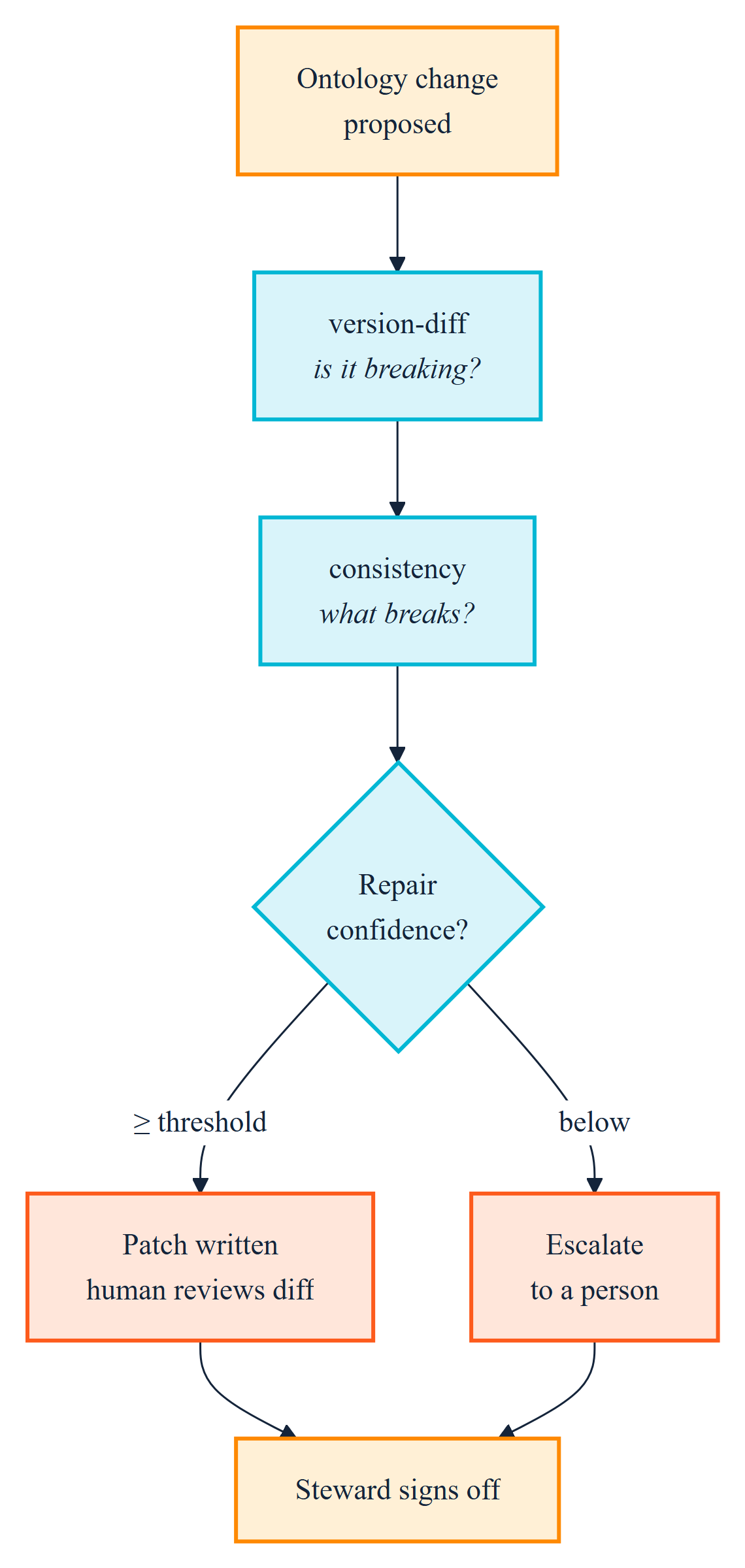
The SemOps overview puts Knowledge Lifecycle Management first and calls it "the backbone of semantic governance" — versioning, schema evolution, change-impact analysis, approval workflows. This chapter is the most directly governance-facing in the manual, and it is where the toolchain does something genuinely unusual: it turns "is this a breaking change?" from an opinion into a command.
12.1 Evidence-based semver: version-diff
python -m ontology_suite version-diff \
  examples/acme_robotics/acme-org-v1.ttl \
  examples/acme_robotics/acme-org-v2.ttl \
  --exclude-imports --out-dir out/version-diff --json
Real output:
Removed classes [MAJOR]:
  - acme:Engineer

Removed subclass edges [MAJOR]:
  - acme:Engineer no longer rdfs:subClassOf acme:Employee

Added classes [minor]:
  - acme:ProductManager
  - acme:SoftwareEngineer

Added properties [minor]:
  - acme:hireDate

Added subclass edges [minor]:
  - acme:ProductManager rdfs:subClassOf acme:Employee
  - acme:SoftwareEngineer rdfs:subClassOf acme:Employee

Added equivalentClass axioms [minor]:
  - acme:Engineer equivalentClass acme:SoftwareEngineer

Suggested version bump: MAJOR
Note the argument order: old first, then new. Reversed, you get a diff describing the inverse release.
Note also --exclude-imports here, where §12.2 uses --import-dir. That is deliberate, not a slip. version-diff is comparing Acme's own axioms against Acme's own axioms, and merging two identical copies of org: and FOAF into both sides adds nothing but time. consistency needs the opposite, because its TARQL-alignment check reads the transformation's vocabulary: without FOAF resolved, foaf:name and foaf:mbox are reported as undeclared properties that the ontology set does not contain. Resolve imports when a check reasons about terms you did not define; exclude them when it only compares terms you did.
The verdict is derived from what happened to the axioms, not from what the author believed they were doing. One removed class makes it MAJOR regardless of the seven additive changes surrounding it, and regardless of anyone's view that "nobody was using Engineer anyway."
That property is what makes it useful as a governance instrument. The release conversation stops being "do you think this is breaking?" — a question where the most confident person in the meeting tends to win — and becomes "the diff says MAJOR; who signs off?"
--fail-on major makes it enforceable, and --json writes diff.json alongside the human-readable diff.txt, which is what Chapter 3 recommends attaching to a partner-facing change notice so downstream tooling can act on it without parsing prose.
12.2 Change impact: consistency
Knowing a release is breaking is half the answer. What breaks is the other half.
The fixture's transformation query types every employee acme:Engineer — the exact term v2 renames.
python -m ontology_suite consistency \
  --new examples/acme_robotics/acme-org-v2.ttl \
  --old examples/acme_robotics/acme-org-v1.ttl \
  --queries examples/acme_robotics \
  --import-dir examples/acme_robotics \
  --out-dir out/consistency
consistency runs the version diff and checks every transformation query against the new ontology:
Suggested version bump: MAJOR

1 class(es) used in TARQL but not declared in the ontology set:
  [undeclared_class] acme:Engineer

1 suggested repair(s):
  [rename_iri] examples\acme_robotics\employees.rq (confidence 100%)
    Update to the renamed ontology term(s): acme:Engineer -> acme:SoftwareEngineer

Wrote 1/1 suggested repair(s) as .patch files under out/consistency/repairs
(confidence >= 50%). Re-run with --apply-repairs to apply them directly.
This is SemOps' "change-impact analysis" and "approval workflows for model changes" made concrete. The steward approving this release is not being asked to imagine consequences; they are looking at the affected file, the affected term, and a proposed fix with a confidence score.
By default nothing is modified — repairs are written as reviewable .patch files under --out-dir/repairs.
12.3 The migration annotation, and its direction
The 100% confidence above is not pattern-matching on names. It comes from an explicit migration annotation in v2:
acme:Engineer owl:equivalentClass acme:SoftwareEngineer .The gotcha that costs an afternoon: rename detection recognises this annotation in one direction only — asserted from the old, retiring IRI to the new one.
owl:equivalentClassis logically symmetric, and any reasoner treats both directions identically, but writing it the other way round —acme:SoftwareEngineer owl:equivalentClass acme:Engineer, arguably the more natural way to write "here is the new term and what it replaces" — silently drops confidence to name-similarity guessing.
The failure is silent, which is what makes it expensive: you get a lower confidence score and a repair that may fall below your threshold, with nothing saying why.
Always assert the migration annotation from the retiring IRI. Make it a review checklist item. Across an organisational boundary (Chapter 3) it is the difference between a partner's tooling identifying the replacement automatically and a human reading your release notes.
12.4 Applying repairs
python -m ontology_suite consistency \
  --new acme-org-v2.ttl --old acme-org-v1.ttl \
  --queries . --import-dir . \
  --apply-repairs --min-confidence 0.7 \
  --out-dir out/consistency
Applied 1/1 suggested repair(s) directly to their target files (confidence >= 70%).Verified against a scratch copy. Before:
?employee a acme:Employee, acme:Engineer ;After:
?employee a acme:Employee, acme:SoftwareEngineer ;The confidence gate is the safety mechanism: a 100%-confidence rename backed by an explicit annotation applies at a 0.7 threshold; a name-similarity guess does not. Automate what is evidenced; escalate what is inferred.
It used to mangle comments, and the fix is instructive
The repair was once a textual substitution across the whole file, comments included. The fixture's query carries an explanatory comment:
#   - every row is typed acme:Engineer, which v2.0.0 renames to
#     acme:SoftwareEngineer (with a migration annotation) -- this query is
After --apply-repairs, that comment reads:
#   - every row is typed acme:SoftwareEngineer, which v2.0.0 renames to
#     acme:SoftwareEngineer (with a migration annotation) -- this query is
— nonsense, and worse than leaving it alone. Comments do not execute, so nothing broke; the next reader was simply told something false.
It now substitutes outside comments only, so that line survives intact while the code on line 14 is rewritten. Verified both parts.
The judgement underneath is worth borrowing. String literals are still rewritten, deliberately: in a TARQL query an IRI template is built out of them — CONCAT("acme:_Engineer_", ?id) — so a term rename usually must reach inside a literal. That is a decision about this domain, not a general rule, which is why the fix is not simply "substitute outside comments and strings".
The same defect existed in the editor, and neither side knew. The extension's rename and find-references made the identical mistake for the identical reason, and both were fixed in the same week, independently, in two languages (Chapter 8 §8.1). The comment scanner is one of a handful of algorithms written twice rather than shared as data, which is exactly the class of thing the registry's parity test cannot see — the argument, and what was done about it, is in Chapter 7 §7.1.
The practical consequence is unchanged: prefer the default dry-run in automation, review the .patch files, and apply. --apply-repairs suits a developer who will read the diff before committing, not an unattended job that commits its own output.
12.5 The taxonomy layer: pattern-consistency
consistency has a documented blind spot: it has no notion of a taxonomy — a controlled vocabulary of permitted values sitting on top of the ontology. pattern-consistency checks that boundary and the three around it together: ontology ↔︎ taxonomy ↔︎ transformation ↔︎ output data.
The fixture is built to exercise exactly this. taxonomy.ttl declares three valid departments as SKOS concepts:
dept:ENG a acme:Department, skos:Concept ;
    skos:inScheme acme:DepartmentTaxonomy ;
skos:prefLabel "Engineering"@en .ENG, QA and SALES. But employees.csv contains a row whose department is MKT.
python -m ontology_suite pattern-consistency \
  --queries examples/acme_robotics \
  --ontology examples/acme_robotics/acme-org-v1.ttl \
  --ontology examples/acme_robotics/reference_vocab/foaf.rdf \
  --taxonomy examples/acme_robotics/taxonomy.ttl \
  --output-data out/triplify/employees.ttl \
  --out-dir out/pattern-consistency
== taxonomy <-> output data ==
[undeclared_taxonomy_reference] .../data/department/MKT is used as the
value of acme:worksIn in the data graph but is not declared as an
individual anywhere in the given taxonomy set.Caught. And the mechanism matters, because it is not the obvious one.
The transformation does not hard-code MKT anywhere. The department IRI is built dynamically, per CSV row:
BIND(IRI(CONCAT(..., ?department)) AS ?dept)There is no fixed literal in the query text for a text-level check to flag. The taxonomy↔︎transformation check — which looks for values hard-coded in the query template — cannot see this, and correctly reports nothing. It is the --output-data layer that catches it, by comparing the values that actually appeared in the produced graph against the declared taxonomy.
This is worth dwelling on as a general principle:
A value that varies per data row cannot be validated by reading the transformation. It can only be validated by inspecting the output. Any pipeline whose controlled values come from data rather than from the query text needs the output-data layer in its gate, not just the static checks.
Omit --output-data and this run reports clean — correctly, and uselessly.
Note the two
--ontologyarguments.foaf.rdfis passed explicitly because the transformation usesfoaf:nameandfoaf:mbox; without it, both are reported as undeclared properties.--ontologyis repeatable, andpattern-consistencyrequires--queries,--ontologyand--taxonomy—--output-datais the optional one, and the one that does the most work.
12.6 Governance: what the tooling does and does not do
SemOps layer 1 wants approval workflows, stewardship roles and audit trails. None of that is implemented here, and no tool should claim otherwise. What the toolchain provides is the evidence an approval decision needs:
| Governance question | Command | Evidence produced |
|---|---|---|
| Does this PR introduce a new problem in code we own? | checks --own-namespace --fail-on Violation |
Pass/fail + findings scoped to your terms |
| Is this breaking, and does it need sign-off? | version-diff --fail-on major |
MAJOR/minor/patch + the axioms behind it |
| What exactly breaks downstream? | consistency |
Affected files, terms, and proposed repairs |
| Can any of it fix itself? | consistency --apply-repairs --min-confidence |
Confidence-gated patches |
| Do controlled values still hold? | pattern-consistency --output-data |
Values in data absent from the taxonomy |
The approval workflow — a branch protection rule requiring a named reviewer when version-diff reports MAJOR — is a policy layered on top. That is the correct division: the tool establishes facts, the organisation decides what to do about them. A tool that tried to encode the decision would be wrong about it within a quarter, because Chapter 2's territorial dynamics change faster than any configuration file.
For sequencing and rollback across an ontology/taxonomy/data rollout, the suite's own UPDATING.md is the closest existing document to a governance playbook.
Run it: notebook 3 — Release and change takes an ontology through a breaking release and applies the repair, including the comment it mangles on the way.
12.7 Maturity checkpoint
version-diff on every release, consistency before merging a breaking change, and pattern-consistency --output-data where controlled vocabularies exist, covers Level 3's change-management dimension and reaches into Level 5's "continuous semantic improvement loops" — the diff → impact → repair cycle, run routinely, is the closest this toolchain gets to Level 5.
The rest of Level 5 is organisational, and no command produces it.