 The SemOps Manual
9. Continuous integration
Part III — The practice · SemOps stage 3 · Operating-model layer 3
Stories answered here As a SemOps engineer, I want bad semantic changes rejected automatically, and I want the rejection to be about our code.
Stage 3 is where SemOps stops being a philosophy. The blueprint's stated goal is blunt — "automatically reject bad semantic changes" — and the mechanism is almost embarrassingly simple: one flag, --fail-on, and a non-zero exit code.
The simple part takes a paragraph. The rest of this chapter is about the part that actually determines whether the gate survives its first month, which is what the gate reports.
9.1 The mechanism
python -m ontology_suite ontology \
  --ontology examples/acme_robotics/acme-org-v1.ttl \
  --import-dir examples/acme_robotics \
  --fail-on Violation
--fail-on takes Violation, Warning, Info or never. The command exits non-zero when a finding at or above that severity exists. Against the fixture this exits non-zero, because LOG-001 — the deliberate Contractor/Employee contradiction — is a real Violation.
That is the whole gate. version-diff has its own variant (--fail-on major), and consistency and pattern-consistency use --fail-on-misalignment and --fail-on-mismatch; nothing more exotic is needed for a green/red build.
9.2 The problem: 479 findings
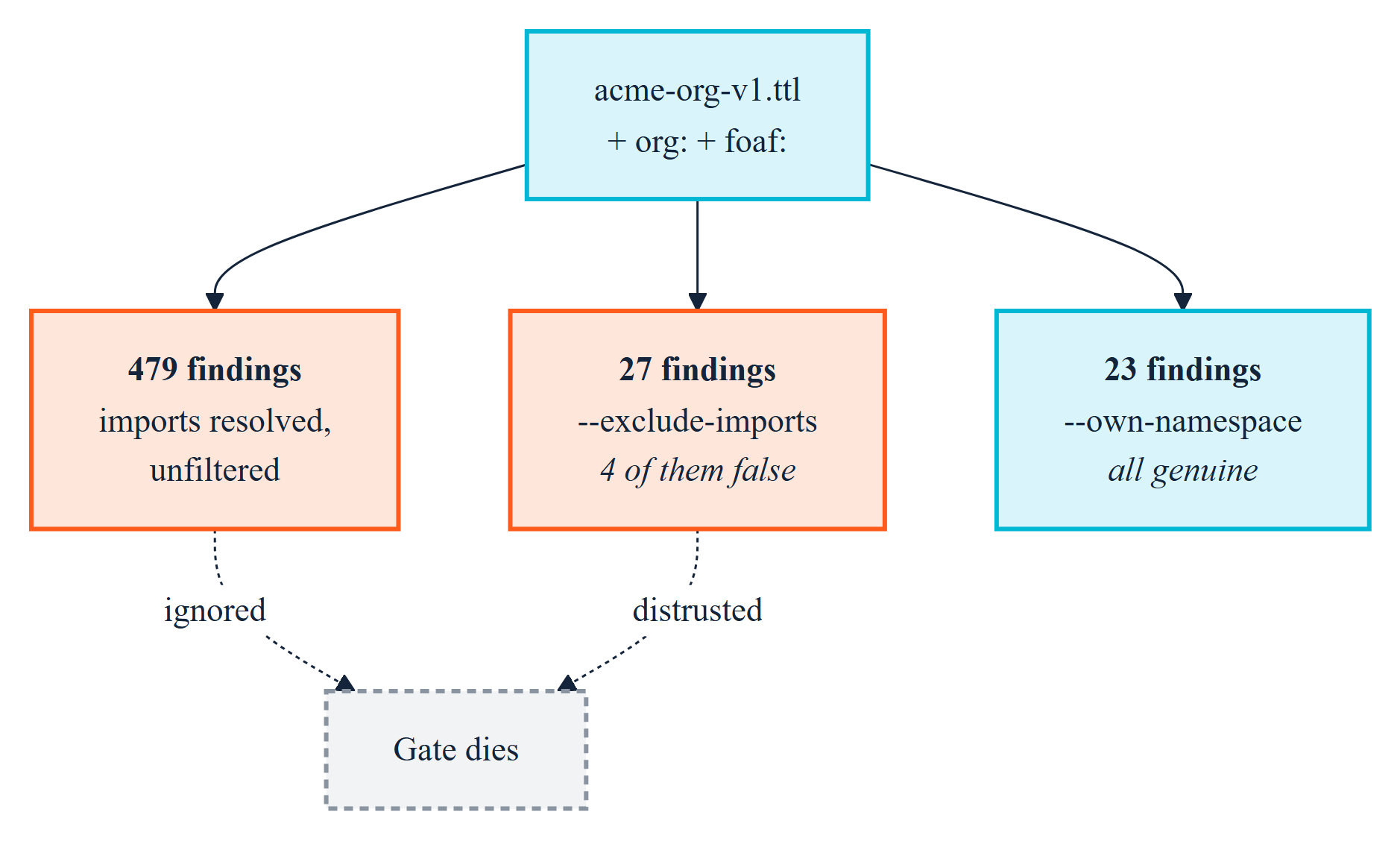
Now run the full registry the obvious way — the whole 61-check catalogue against the ontology, with its real org: and FOAF imports resolved:
python -m ontology_suite checks \
  --ontology examples/acme_robotics/acme-org-v1.ttl \
  --import-dir examples/acme_robotics \
  --engine sparql --out-dir out/checks --fail-on never
Findings: 479 total (55 Violation, 340 Warning, 84 Info)Three consecutive runs give 479 every time. That has not always been true. An earlier edition reported "close to 300" with an observed drift of 289–298, traced to several registry
CONSTRUCTs binding two values per result —LOG-004's two inverses,LOG-006/007's domain and range,REA-001's two disjoint classes — while the merge step read an arbitrary single one and deduplicated on it. Values are sorted and joined now, and the report shows both instead of half the finding.The number then moved again, from 301 to 479, without the fixture changing at all: the registry grew from 50 checks to 61, and two of the new ones —
QUA-009(noskos:prefLabelper language) andQUA-010(noskos:definition) — fire on every undocumented term. A registry upgrade changes your findings while your ontology sits still. Pin the version of the suite in CI the way you pin any other dependency, and read a jump in the count as "the rules moved" before assuming "the model got worse".The lesson underneath both episodes is §9.8's: a count is a fragile thing to assert on. Across every one of those changes, the set of check identifiers behaved sensibly — it grew when checks were added and was otherwise stable.
Every one of those findings is real. The suite is genuinely checking every triple in the merged graph — and the merged graph includes the entire W3C Organization Ontology and the entire FOAF vocabulary, complete with their own internal documentation habits, blank-node axiom style and naming choices.
Wire that into CI with --fail-on Violation and you have gated your build on 55 violations, of which exactly one is yours. What happens next is predictable and happens every time: the team triages it once, concludes the tool is noisy, and either switches the gate off or adds || true. The 23 findings that were genuinely theirs are lost with the other 456.
This is the single most common way a semantic quality gate dies. Not because the checks are wrong — they are not — but because Chapter 2's cognitive budget was never considered. A gate nobody triages is not a gate.
So: whose problems are these? A domain steward owns the correctness of their own additions to a shared vocabulary. They do not own the W3C's internal SHACL cleanliness, and cannot fix it.
9.3 The obvious fix is wrong
The instinctive move is to stop resolving the imports at all:
python -m ontology_suite checks \
  --ontology examples/acme_robotics/acme-org-v1.ttl \
  --exclude-imports \
  --engine sparql --out-dir out/checks_excl --fail-on never
479 findings become 27. Enormously better, and still wrong. Here is the full breakdown:
 2 × DAT-002  Warning    Dangling IRI reference
 1 × LOG-001  Violation  Class disjoint with its own ancestor
 1 × QUA-001  Warning    (missing label)
 3 × QUA-004  Warning    Resource missing skos:prefLabel
 9 × QUA-009  Warning    No skos:prefLabel per language
 9 × QUA-010  Warning    No skos:definition
 1 × STR-003  Warning    (missing domain/range)
 1 × STY-002  Warning    (naming style)
Inspect the two DAT-002 findings and the cause is immediate:
focus = acme:1.0.0            path = owl:imports        value = http://xmlns.com/foaf/0.1/
focus = acme:Employee         path = rdfs:subClassOf    value = http://xmlns.com/foaf/0.1/Person
Both point at FOAF. acme:Employee is a subclass of foaf:Person, and with imports excluded, FOAF is not loaded, so foaf:Person looks like a dangling reference. It is not dangling; it is simply absent. Two of the three QUA-004 findings are the same artefact — they are against foaf: itself and foaf:Person, terms whose labels live upstream in a file you just declined to read.
--exclude-imports traded 456 irrelevant findings for 4 false ones. In some ways that is a worse failure: irrelevant findings get ignored, but false findings get investigated, and an engineer who spends an afternoon proving that acme:Employee is fine learns exactly the same lesson about the tool's trustworthiness.
9.4 The right fix: --own-namespace
Keep the imports resolved — so upstream context is real, foaf:Person genuinely exists, and cross-vocabulary reasoning works — and filter the report to findings whose focus node lies in your own namespace:
python -m ontology_suite checks \
  --ontology examples/acme_robotics/acme-org-v1.ttl \
  --import-dir examples/acme_robotics \
  --engine sparql \
  --own-namespace "https://acme.example.org/ns/" \
  --out-dir out/checks_own --fail-on never
1 × LOG-001 Violation Class disjoint with its own ancestor
1 × QUA-001 Warning (missing label)
1 × QUA-004 Warning Resource missing skos:prefLabel -> acme:hasSkill
9 × QUA-009 Warning No skos:prefLabel per language
9 × QUA-010 Warning No skos:definition
1 × STR-003 Warning (missing domain/range)
1 × STY-002 Warning (naming style)Twenty-three findings. All twenty-three are Acme's. None are artefacts. Exact across repeated runs, with the same check identifiers every time.
Eighteen of them are the documentation pair, QUA-009 and QUA-010, firing once each on all nine of Acme's terms — the fixture declares rdfs:label on most of them but no skos:prefLabel and no skos:definition anywhere. That is a fair finding rather than noise, and it is a useful shape to recognise: a check that fires on every term is telling you about a policy you have not adopted, not about nine separate mistakes. Decide whether you want SKOS documentation; if you do, it is one pass of work, and if you do not, the --registry mechanism in Chapter 8 lets you drop both checks.
Compare the three runs directly — all three are the same ontology, the same registry, the same engine:
| Run | Findings | Genuinely yours | Upstream noise | False |
|---|---|---|---|---|
--import-dir alone |
479 | 23 | 456 | 0 |
--exclude-imports |
27 | 23 | 0 | 4 |
--own-namespace |
23 | 23 | 0 | 0 |
All three are now exactly reproducible across repeated runs. That was not true of the first row until recently, and the fact that it is the row you are being told not to use was a happy accident rather than a design.
A real mistake worth repeating
The first attempt at that command, while writing this manual, used --own-namespace "http://example.org/acme#" and returned:
Findings: 0 total (0 Violation, 0 Warning, 0 Info)A confidently empty report, and at the time indistinguishable from a passing gate. The fixture's namespace is https://acme.example.org/ns/ — different scheme, host and separator. --own-namespace is a literal IRI-prefix string match, not a prefix-name lookup.
The tool now says so. Reported from this manual's own use, the same command today prints, before the count:
WARNING: --own-namespace http://example.org/acme# matched none of the 479
findings, so this run reports nothing. It is a literal IRI-prefix match --
check the scheme, host and trailing separator against the ontology's own
@prefix line. Namespaces actually seen: http://purl.org/dc/elements/1.1/, …
Note where the warning does not fire: when there were no findings to lose in the first place. A filter matching nothing on a genuinely clean run is not an error, and warning there would train people to ignore the message.
The warning goes to stderr, so a CI step that captures only stdout will not show it. Two lessons survive the fix:
- Copy the namespace from the ontology, never from memory. It is the string after
@prefix, in full, including the trailing/or#. - Verify the filter with a known-failing input once, and keep that check. A gate that cannot fail is indistinguishable from a gate that passes.
--verbose prints what every option actually resolved to before running, and is the first thing to reach for when a result looks surprising — including this one.
When to run the wide pass anyway
Do not discard the wide run; just stop putting it on the pull-request path. Run it periodically, or when an imported vocabulary changes — as an audit rather than a gate. That is when "FOAF published a new version and something in it now conflicts with our assumptions" becomes findable, and it is a genuinely different question from "did this PR break anything."
| Cadence | Command | Purpose |
|---|---|---|
| Every PR | checks --own-namespace <yours> --fail-on Violation |
Gate |
| Weekly / on upstream change | checks --import-dir … --fail-on never |
Audit |
9.5 Wiring it up
The pattern generalises to three gate types, one per kind of pull request.
name: semantic-ci
on: [pull_request]

jobs:
  ontology:
    runs-on: ubuntu-latest
    steps:
      - uses: actions/checkout@v4
        with:
          # version-diff compares against the base branch, so the default
          # shallow checkout is not enough.
          fetch-depth: 0
      - uses: astral-sh/setup-uv@v5
      - run: uv sync

      # 1. Is the schema itself sound?
      - name: Ontology quality gate
        run: |
          uv run ontology-quality-suite ontology \
            --ontology ontology/acme-org.ttl \
            --import-dir lib/vocab \
            --fail-on Violation

      # 2. Does it pass our rules, scoped to terms we own?
      - name: Registry checks (our namespace only)
        run: |
          uv run ontology-quality-suite checks \
            --ontology ontology/acme-org.ttl \
            --import-dir lib/vocab \
            --own-namespace "https://acme.example.org/ns/" \
            --engine sparql \
            --fail-on Violation

      # 3. Is this release breaking, and does anything downstream break with it?
      - name: Change impact
        run: |
          # The "old" side is the ontology as it stands on the base branch.
          git show "origin/${{ github.base_ref }}:ontology/acme-org.ttl" > /tmp/base.ttl
          uv run ontology-quality-suite version-diff \
            /tmp/base.ttl ontology/acme-org.ttl \
            --json --fail-on major
        continue-on-error: true   # informational: a MAJOR bump needs sign-off, not a block

      - uses: actions/upload-artifact@v4
        if: always()
        with:
          name: semantic-reports
          path: out/
Four points about that job.
Keep local copies of your imports. --import-dir lib/vocab resolves owl:imports against files in your own repository. --allow-network exists, and CI is the last place you want it: a build whose result depends on a third party's uptime is not reproducible, and an upstream vocabulary that changes silently changes your gate silently.
Upload the reports as artefacts. Every run writes rather more than the two files this manual has been quoting, and the extras are the ones that reach people who do not read CSVs:
| File | Who it is for |
|---|---|
report.html |
A reviewer, reading the findings |
full_results.csv |
Diffing between runs; the raw record |
summary_by_check.md, summary_by_category.md |
A pull-request comment, or a status page |
top_offenders.md |
"What should we fix first?" |
cucumber.json |
Any CI system that already renders BDD results |
features/, plots/ |
The generated feature files and charts behind the above |
cucumber.json is the one worth knowing about. Each check becomes a scenario under its category, with Given/Then steps and a pass/fail status:
Feature:  Structural Integrity
Scenario: [STR-001] Every rdf:type used on an instance resolves to a
          declared class
  Given the combined ontology and data graph        passed
  Then  Every rdf:type used on an instance …        passed
That format is understood by essentially every CI system's test reporting, which means semantic quality can appear on the same dashboard as unit tests without anyone writing an integration — and, per Chapter 2, it renders findings in a form a non-specialist can read. The cucumber_feature and cucumber_scenario fields in a registry entry (Chapter 8) are what populate it, which is a reason to fill them in on your own house rules.
All of these are written on every run regardless of exit code.
A MAJOR bump should not block the build. It should demand a human. The job above records it and continues; the enforcement belongs in a branch protection rule requiring a named reviewer, which is a governance control rather than a technical one. See Chapter 12.
Different PRs need different gates:
| PR touches | Gate to run |
|---|---|
| The ontology | ontology, then checks --own-namespace |
| A transformation query | sketch first — it needs no CSV (Ch. 10) |
| A taxonomy of controlled values | pattern-consistency (Ch. 12) |
| Data | data, with --sample N if the graph is large |
9.6 The one-command version
Once you know which stages apply, run composes them into a single merged report:
python -m ontology_suite run \
  --ontology examples/acme_robotics/acme-org-v1.ttl \
  --import-dir examples/acme_robotics \
  --queries examples/acme_robotics \
  --own-namespace "https://acme.example.org/ns/" \
  --engine sparql --fail-on Violation --out-dir out
Convenient for a nightly job. Less good as a PR gate, because a single merged pass/fail tells a reviewer less than three named steps that each fail for a stated reason. Prefer the explicit steps where a human reads the result.
9.7 Across the boundary
Chapter 3 noted that the gate has no jurisdiction outside your own organisation. The mechanics are unchanged; the disposition of the output is not:
| Internal | Cross-boundary | |
|---|---|---|
| Non-zero exit | Blocks the merge | Generates a notice with a deadline |
report.html |
A reviewer reads it | The partner reads it |
| The registry directory | Internal config | A published artefact partners run themselves |
That last row is the highest-leverage cross-boundary move available, and it costs nothing you have not already built: your check registry is a directory of files, and --registry/--shapes/--sparql means a partner can point at it and validate before submitting rather than after being rejected.
Run it: notebook 1 — Validation and the gate builds a miniature version of this chapter's fixture and walks the same comparison, including the near-miss filter that returns an empty report.
9.8 Testing the gate itself
Everything so far has used the gate to test an ontology. This section is the other direction: how do you know the gate still works?
It is a real question, and the suite's own history answers it. Four times it has shipped a check that quietly matched nothing — REA-001 on a bad symmetry assumption, DAT-001 twice (a UNION of FILTER-only branches that matches nothing under rdflib, and a boolean branch made unreachable because rdflib rewrites the stored lexical form of an ill-typed boolean), and EFF-002 with an unjoined $this. Each was found only by running it against real data.
A check that cannot fire is worse than no check, because it looks like coverage. It sits in the registry, it appears in the catalogue, it never produces a finding, and everyone concludes that part of the model is clean.
The pattern: a fixture per error category
The practice that catches this is a companion repository of deliberately broken ontologies, each isolating one category of error, each asserting the check identifiers it must trigger. The one this section describes is real and public — consolidated-ontology-quality-suite-python-testing — so the tables below can be read against the fixtures themselves and the harness:
| Fixture | Seeded error | Must report |
|---|---|---|
01-clean |
(none — control) | no Violation, no Warning |
03-disjoint-classes |
class disjoint with its own superclass | LOG-001, REA-001, REA-020 |
06-datatype-conformance |
ill-formed xsd:date/integer/boolean |
DAT-001, CNF-003, CNF-004 |
07-naming-style |
snake_case class, untagged label, deprecated term |
STY-001, STY-002, STY-003, QUA-001 |
09-profile-violations |
unionOf, complementOf, minCardinality 4 |
REA-010, REA-011, REA-012 |
Three details make it work, and all three are worth copying.
Assert check identifiers, not counts. This is the whole trick. A regression then shows up as "LOG-004 no longer fires" — a named, actionable failure — rather than as "expected 85 findings, got 83", which tells you nothing about what broke. It also survives exactly the kind of churn this manual has been documenting: while the unscoped total was drifting between 289 and 298, the set of check identifiers never moved, so a suite built on identifiers stayed green and meaningful throughout.
Keep a clean control. One fixture with no seeded error at all, declaring its labels, domains, ranges and metadata properly, producing no Violation and no Warning. Without it you cannot attribute findings in the other fixtures to their seeded errors rather than to background noise — and the first draft of that control found a real inconsistency, STR-002 flagging skos:prefLabel where its broader sibling STR-007 stayed quiet about the same predicate.
Mark the error in the fixture. Every seeded fault carries an # ERROR: comment naming the check it should trigger, so the fixture documents its own intent and a reader can tell a deliberate fault from an accidental one:
# ERROR: class local name is snake_case, not UpperCamelCase -> STY-001
# ERROR: no rdfs:label / skos:prefLabel at all               -> QUA-001
:person_record a owl:Class ; rdfs:subClassOf owl:Thing .
Four assertions, not one
"Did the expected checks fire" is the obvious test and the weakest of the four worth writing. The full set:
| Assertion | Guards against |
|---|---|
| Expected ids fired | A check silently ceasing to work |
| Forbidden ids did not fire | False positives — a check becoming over-eager |
| Severity ceiling | A finding quietly escalating; the clean control must produce nothing above Warning |
| Optional-reasoner ids — asserted only when it ran | A flaky optional dependency turning into a red build |
The second is the one teams skip, and it is what caught STR-002 flagging skos:prefLabel where its broader sibling stayed quiet. A check that starts firing when it should not is as much a regression as one that stops firing — and it is the more damaging of the two, because it erodes trust in every other finding in the report.
The fourth deserves its own note, because it is Chapter 4's argument made executable. Findings that only a full DL reasoner can produce — REA-020, REA-021 — are asserted only when that reasoner actually ran, and reported as skipped otherwise. An optional dependency that fails a build when it is absent is not optional; one that silently reduces coverage is worse. Skipping, visibly, is the third option and the right one.
Two practical traps
Test against the library, not the report. The harness imports ontology_suite.pipeline and compares structured result rows rather than scraping report.html. Report formats change; a test suite coupled to their text breaks for reasons that have nothing to do with the ontology.
A non-zero exit from a broken fixture is success. The CLI exits 1 whenever a Violation is found, so every deliberately-broken fixture exits 1 — that is the fixture working. Wire that into CI naively and your fixture suite fails permanently. Either assert on the findings rather than the exit code, or pass --fail-on never when the exit code is not what you are testing.
The stage decides which checks can fire at all
Worth knowing before you conclude a check is broken: the three stages expose different layers, and a check cannot fire in a stage that never runs it.
| Stage | What runs | What cannot fire |
|---|---|---|
checks --ontology |
Registry SHACL + SPARQL over the ontology alone | Conformance (CNF-*), reasoning |
data <file> --ontology |
The full pass — registry, ontology-vs-data conformance, owlrl closure and HermiT |
Nothing, but it is the slowest |
ontology --ontology |
The as-authored evaluation | Everything except profile membership — and that only with --profile |
REA-010/011/012 — the OWL2 profile checks — are the sharp case: they fire only from ontology, and only when --profile is passed. A team that runs checks and concludes their ontology is EL-clean has not tested that at all.
It pays for itself
That companion repository is what surfaced the merge nondeterminism in §9.2, the severity misplacement in Chapter 7 §7.4, and the unreachable DAT-001 branch — all of which are now fixed. Thirteen fixtures asserting 35 of the 50 checks the registry held at the time was enough to find four real defects in the tool they were testing.
Its COMMANDS.md gives every fixture as both a harness invocation and the equivalent bare CLI command, which makes it usable as a worked reference for the suite generally, not only as a test suite. The two experiments/ scripts are worth a look as well: each isolates one of the defects above to about thirty lines, which is a good model for reporting a tool bug you want fixed rather than argued about.
The general form, for your own house rules (Chapter 8): every check you write gets a fixture that makes it fire, and the suite asserts it fires. Otherwise you find out it never did on the day it mattered.
9.9 Maturity checkpoint
A team running these gates on every pull request, with reports retained, is at maturity Level 3 — Automated Semantic Delivery for the validation dimension: predictable releases, faster iteration, early detection of semantic regressions.
Level 3's other dimensions — automated packaging, deployment to dev/test, orchestrated ETL, ingestion monitoring — are partly Chapter 10 and partly not covered by this toolchain at all (Chapter 14).
This is the transition worth spending real effort on. It is also the one that makes agent participation safe: as Chapter 5 argues, a gate that genuinely rejects bad changes is what lets you accept proposals from a much higher-throughput source without accepting the risk that comes with it.