 The SemOps Manual
1. The business case
Part I — Why this is hard
The SemOps strategy material opens with capability: knowledge lifecycle management, CI/CD, observability, governance. All correct, and all of it answers the question "what would good look like?" — which is not the question anyone gets asked when they request budget. The question they get asked is "what is broken today, what does it cost, and how will I know this fixed it?"
This chapter is about answering that question, because semantic programmes fail at the funding stage far more often than at the modelling stage.
1.1 The four business problems that are actually semantic
Most data problems are not semantic problems and should not be sold as such. The ones that genuinely are share a signature: the data is present, correct, and still produces the wrong answer, because two systems disagree about what a word means.
Four patterns cover most of the real cases.
Reconciliation tax
Two departments report a number. The numbers differ. Nobody can say which is wrong, because "active customer" means billed in the last 90 days in finance and logged in within 90 days in product. Neither is wrong; they are answers to different questions wearing the same label.
The cost is not the discrepancy. It is the standing army of reconciliation — the recurring analyst hours spent explaining the difference, the meeting that happens every month, the fortnight before every board pack. This cost is measurable, and almost nobody measures it, because it is distributed across dozens of people's calendars in slices too small to appear in any budget line.
Instrument it first. Before proposing an ontology, count the hours. Ask four analysts to tag a fortnight of calendar time as "reconciling definitions." The resulting number is usually large enough to fund the programme on its own, and — critically — it is a number that already exists in the business's own terms, rather than one you have to teach them to care about.
Integration cost that scales quadratically
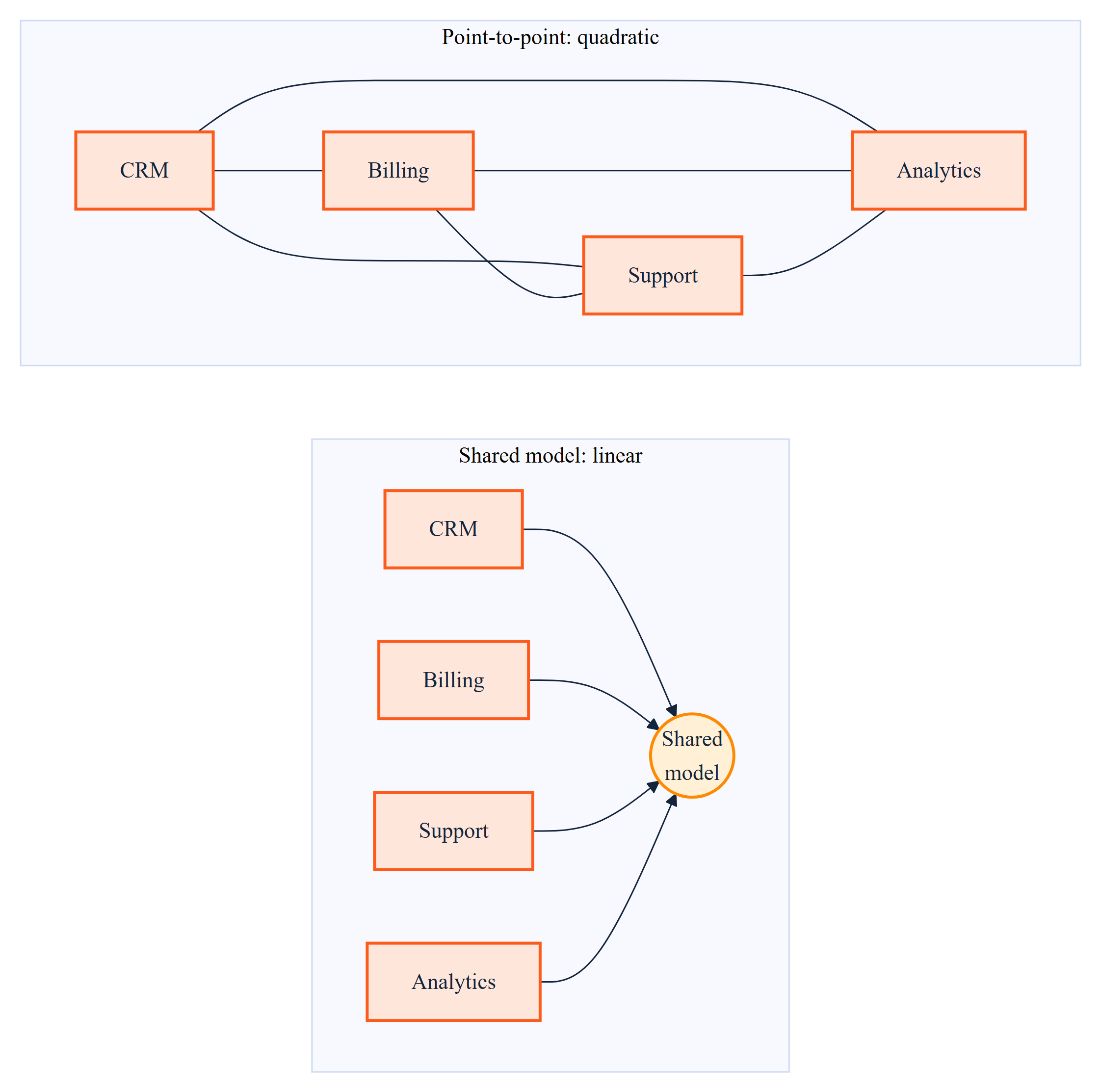
Every new system integrated point-to-point with n existing systems costs n mappings. Ten systems is forty-five potential pairings; twenty is a hundred and ninety. Teams feel this as "integrations take longer every year" and diagnose it as a staffing problem.
A shared model changes the exponent, not the constant. Each system maps once, to the model. The pitch is not "we will make this integration cheaper" — it will not, the first one is more expensive — it is "we will stop the curve bending."
The honest caveat, which you should say out loud before someone else does: the shared model is itself an asset that must be maintained, and an unmaintained shared model is worse than point-to-point mappings because it carries authority it no longer deserves. That maintenance burden is precisely what the rest of this manual automates — it is the reason SemOps exists as a discipline rather than as a modelling exercise.
Provenance you cannot reconstruct
A regulator, an auditor, or a customer asks "where did this figure come from?" and the answer takes three weeks and two people who happen to remember. In regulated sectors this is not an efficiency problem, it is an existential one: the inability to evidence lineage can invalidate the figure regardless of whether it was correct.
This is the pattern with the clearest financial framing, because the downside is a number someone has already written down — the fine, the qualification, the remediation programme.
Knowledge that leaves with the person
The system works because Margaret knows that the STATUS field means something different for records created before the 2019 migration. Margaret retires in March. Nothing in any system records what Margaret knows.
The failure mode is delayed and therefore rarely attributed to its cause: the programme that breaks in eighteen months' time is not connected, in anyone's mind, to the retirement that caused it.
1.2 Why the payoff is invisible
Semantic work has an awkward economic shape. Done well, its payoff is a cost that does not arrive — the outage that did not happen, the reconciliation meeting that got cancelled, the integration that took two weeks rather than two months.
Organisations are structurally poor at valuing avoided costs. The team that prevents ten incidents is less visible than the team that heroically resolves one. This is not irrationality; it is a measurement problem, and it has three practical consequences worth planning around.
Baseline before you build. Once the ontology is in place you can no longer measure what it saved, because the counterfactual is gone. The reconciliation hours, the mean integration lead time, the mean time to answer a lineage question — capture them before anything changes, or you will spend the rest of the programme asserting benefits you cannot evidence.
Pick a first use case with a visible failure. Not the most valuable one; the most legible one. A use case whose current failure mode is embarrassing and specific — a regulator's question that took three weeks — produces a before/after story an executive can retell. A use case whose failure mode is diffuse inefficiency produces a slide nobody remembers.
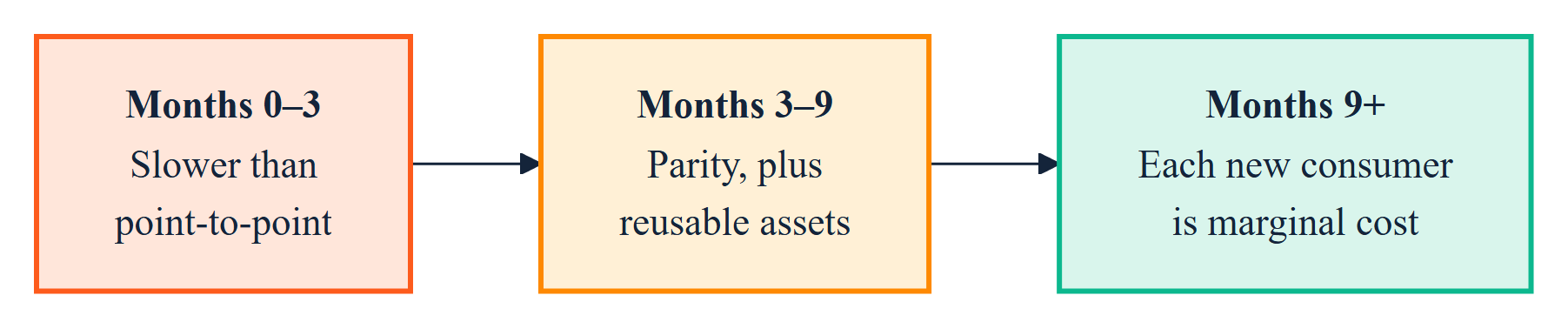
Expect the trough. The first delivery is slower than the point-to-point alternative, because you are building the shared asset and the first consumer of it simultaneously. Say so at the start. A programme that promised acceleration and delivered a trough loses its sponsor in month four; one that predicted the trough and hit it on schedule gains credibility.
1.3 The decay problem, which is the SemOps problem
There is one failure mode that dwarfs the others, and it is the reason this manual exists.
An ontology is most accurate the day it ships. Every day after that, without deliberate maintenance, it decays.
Enterprise ontologies fail in a small number of well-documented ways, and almost all of them are variations on decay:
| Failure mode | What it looks like eighteen months in |
|---|---|
| Business-model drift | Definitions that were precise last year are now misleading — the product line changed, the model did not |
| Unknown unknowns | Expert interviews captured what experts knew; what nobody thought to mention is now baked into the structure |
| Maintenance fatigue | Domain experts stop accepting refinement-workshop invitations. Calendar declines end the programme, not a decision |
| Cross-domain collision | Two separately-built ontologies must reconcile; the integration costs more than either original |
| Governance abandonment | The project ends, the owner moves on, no feedback loop remains, drift is now silent |
Read that table as a specification. Each row is a requirement:
- Drift must be detected mechanically, because humans will not notice it → Chapter 12,
version-diffandconsistency. - Maintenance must cost minutes, not workshops, or fatigue wins → Chapter 8, the in-editor loop.
- Breakage must be caught at the gate, not in production → Chapter 9,
--fail-on Violation. - Ownership must be named and enforced by the pipeline, not by goodwill → Chapter 6, roles.
This is the actual argument for SemOps, and it is worth stating baldly to a sponsor: the risk is not that you build the wrong ontology. It is that you build the right one and then let it rot, at which point it is worse than nothing, because systems and people now trust it.
1.4 What to write on the slide
Three sentences, in this order, is usually enough:
- "Today, [specific, instrumented cost] — N analyst-hours a month, or a three-week lineage question, or an integration curve that has bent 40% in two years."
- "We will fix it for one legible use case, and we expect to be slower for the first quarter."
- "The ongoing cost is automated maintenance, not a standing modelling team — here is the pipeline that does it."
Sentence 3 is the one this manual equips you to make truthfully. Without it, sentence 1 has been pitched — and declined — in most large organisations already.