 The SemOps Manual
2. People and cognition
Part I — Why this is hard
Semantic technology has an unusual property among enterprise technologies: its artefacts are arguments about meaning, and meaning is political. A schema change is a technical act. A definition change is a negotiation about whose account of the business is correct.
This chapter is about the human system the toolchain has to survive contact with. It is not soft-skills garnish appended to the engineering — it determines which technical choices are viable. The reason Chapter 9 recommends a particular CI flag over the obvious one is, in the end, a cognitive argument as much as a correctness one.
2.1 Definitions are territory
When finance and product disagree about "active customer," the disagreement is not a misunderstanding to be cleared up. Each definition is load-bearing for someone's targets, someone's forecast, someone's bonus. Asking the two teams to "agree a single definition" asks one of them to accept a number that makes their performance look worse.
The naive semantic response — both can exist, we will model them as distinct subclasses with clear labels — is technically correct and socially incomplete. It resolves the representation problem while leaving the actual question untouched: which one goes in the board pack?
Three practical consequences:
Model the disagreement, do not resolve it. BilledActiveCustomer and EngagedActiveCustomer as distinct, well-labelled terms is a better outcome than a compromise definition that neither team uses. The ontology's job is to make the distinction visible and unambiguous, not to adjudicate it.
Get the adjudication done by someone with the authority to do it. If the programme requires a decision about which definition is canonical, that decision needs an owner senior enough to make it stick. A knowledge engineer does not have that authority and should not be manoeuvred into pretending they do — the common failure is a modeller quietly picking one, shipping it, and discovering six months later that half the business has been ignoring the model.
Record who decided, and when. Definitions get relitigated. Without the decision trail, the same argument recurs annually with fresh participants and no memory of why the current answer was chosen.
2.2 The priesthood problem
Semantic technology attracts a particular failure: a small group becomes fluent in OWL, SHACL and SPARQL, and gradually becomes the only group that can read the organisation's most important asset.
This feels like success — the team is indispensable — and it is the surest predictor of decay. It produces:
- A review bottleneck. Every change queues behind the same three people.
- Unchallengeable models. Domain experts cannot read the artefact well enough to notice it is wrong, so they stop trying, and the modelling loses its only real error-correction mechanism.
- A bus factor of two, applied to the asset the organisation was told to treat as strategic.
- A veneer of consultation. Workshops happen; experts nod at diagrams they cannot verify; the model records the modeller's understanding, not the expert's.
The counter-measure is not "train everyone in OWL." It is to ensure the artefacts that domain experts must validate are rendered in a form they can actually validate, and that the formal artefact is generated from or checked against that form. Concretely, in this toolchain:
- Generated reference documentation, not raw Turtle, is what goes to a domain expert for review (Chapter 13,
docgen). - The extension's hierarchical outline and graph view render structure visually — a domain expert can see that
Contractorsits underEmployeeand say "no, it does not," without reading a single axiom (Chapter 8). - Check findings carry a human-readable
messageandremediationfield, not just a rule identifier, so a non-specialist can tell whether a finding matters.
A useful test: pick a domain expert who has never written RDF and ask them to find the deliberate error in your model using only the artefacts you would normally send them. If they cannot, your review process is theatre, and the priesthood has already formed.
2.3 Cognitive styles: people do not categorise the same way
Ontology work assumes a particular cognitive style — comfort with abstraction, hierarchy, and the discipline of saying only what is formally true — and then treats people who do not share it as obstacles. They are not; they are the domain.
Four styles show up reliably in modelling sessions. None is wrong, and a session that only accommodates the first will produce a model that is formally elegant and factually incomplete.
| Style | How they answer "what is a Customer?" | What they contribute | How they get lost |
|---|---|---|---|
| Taxonomic | Starts with the general case, refines downward, wants the hierarchy settled first | Structural coherence; spots inconsistent partitioning | Over-abstracts; builds levels nobody needs |
| Narrative / procedural | "Well, when an order comes in…" — tells you the process, not the type | Real edge cases; how the business actually behaves | Frustrated by requests to state things atemporally |
| Exemplar-driven | "Acme Ltd is a customer. So is Bob, sort of." — reasons from instances | Fast falsification of an over-clean model | Resists generalising; every case is special |
| Formal / logical | Asks whether the classes are disjoint and whether the property is functional | Precision; finds the contradictions | Optimises for logical tidiness over usefulness |
The practical move is to elicit in the style the expert has, and translate. An exemplar-driven expert should be shown instances, not a class hierarchy. A narrative expert should be allowed to tell the story, with the modeller extracting types afterwards and playing them back as a story to confirm.
This is also why the fixture in Part III is a small org chart rather than an abstract domain. Employee, Contractor, worksIn are things every style can reason about, which makes it a fair test of tooling rather than a test of whether the reader thinks like a taxonomist.
A specific trap worth naming: the exemplar-driven expert is usually right and usually ignored. When someone says "Bob is sort of a customer," they have found a genuine boundary problem. The taxonomic instinct is to rule it out of scope. Eighteen months later, "sort of" cases are 15% of the data and the model has no place to put them.
2.4 Cognitive capacity is a hard budget
Working memory holds roughly four items. Not four ontology classes — four chunks, where a chunk is whatever the person has already internalised well enough to treat as one thing. An experienced modeller may hold "the employment subtree" as one chunk; a newcomer holds five classes and has nothing left over to reason with.
Every design decision in a semantic toolchain either spends or conserves this budget. Three places where the spending is visible and avoidable:
The 479-finding report
Running the full check registry over the manual's fixture with its real org: and FOAF imports resolved produces 479 findings. Adding a single flag that scopes the report to the terms the team actually owns produces 23.
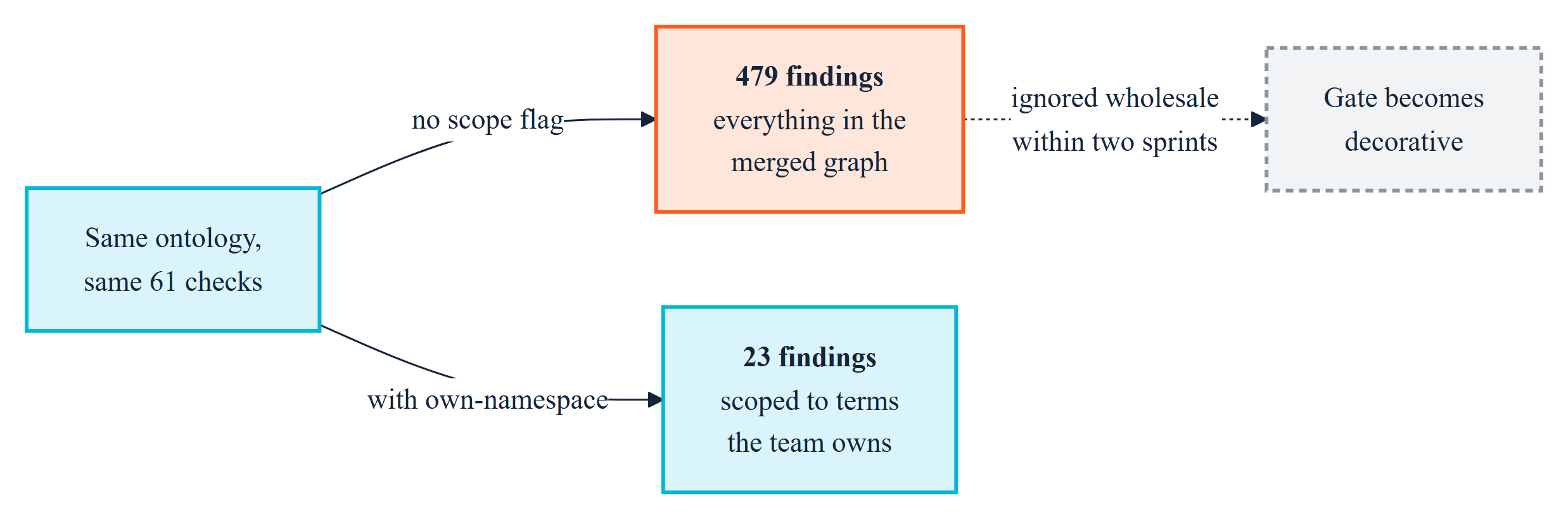
Both numbers are correct. The wide run is genuinely checking every triple in the merged graph, including the internal documentation habits of the W3C Organization Ontology. It is also cognitively useless as a gate: no team triages five hundred findings per commit, so within two sprints the gate is either switched off or ignored, and the twenty-three findings that were actually theirs are lost with the rest.
This is the single most important practical lesson in the manual, and Chapter 9 works through it with the real outputs — including why the obvious way to cut the noise introduces four false findings of its own.
Ontology size versus the review budget
A 40-class ontology can be reviewed by a domain expert in a sitting. A 400-class ontology cannot be reviewed by anyone, in any sitting, ever — it can only be spot-checked. Past that scale, correctness stops being a function of human attention and becomes entirely a function of mechanical checking. Teams routinely cross this threshold without noticing that their quality model has silently changed.
Error messages as cognitive artefacts
LOG-001 means nothing. "Class acme:Contractor is asserted disjoint with its own transitive superclass acme:Employee, which makes acme:Contractor logically unsatisfiable" — followed by "remove either the subclass axiom or the disjointness axiom; the two together are contradictory" — means something to a competent engineer who has never studied description logic. The second form is what the suite actually emits, and it is the difference between a check that teaches and a check that gates.
2.5 The workshop is a social event with a technical output
Domain experts have finite patience for refinement workshops, and maintenance fatigue is a documented killer of enterprise ontology programmes. Calendar declines end more semantic initiatives than technical failures do.
Design accordingly:
- Front-load the expensive human time; automate the recurring part. The first elicitation genuinely needs a room. The 400 subsequent consistency questions do not, and if you spend expert goodwill on them, it will not be there when you need it for the questions only a human can answer.
- Bring falsifiable artefacts, not blank paper. A wrong draft gets corrected in ten minutes; an open question gets a forty-minute discussion and no decision. Experts are far better critics than authors — this is not a failing, it is how expertise works.
- Close the loop visibly. An expert who never sees their correction land concludes, correctly, that the session was extractive. Show the diff.
2.6 What this implies for the toolchain
Everything above resolves into four requirements that Part III should be read against:
| Human problem | Toolchain requirement | Where it lands |
|---|---|---|
| Priesthood, unreadable artefacts | Generated docs and visual structure for non-specialists | Ch. 8, Ch. 13 |
| Cognitive overload at the gate | Findings scoped to what the team owns | Ch. 9 |
| Maintenance fatigue | Drift detected mechanically; repairs proposed automatically | Ch. 12 |
| Territorial definitions | Change impact made explicit before merge, so decisions have evidence | Ch. 12 |
If a tool does not reduce the load on the humans, it will be abandoned regardless of correctness. That is the whole argument, and it is worth carrying into every tooling decision the programme makes.