 The SemOps Manual
11. Rules and inference
Part III — The practice · SemOps element 4 · Operating-model layer 2
Stories answered here As a knowledge engineer, I want the model to derive what follows from the data, rather than making every consumer re-implement the same logic. As a SemOps engineer, I want to know what a rule will do to my gate before I turn it on.
Every chapter so far has treated a graph as something to check. This one is about deriving triples that were never asserted — and about the fact that the moment you do, your gate is validating data that did not exist when the commit was made.
SemOps names this as its own element — Reasoning & Inference Operations: rule deployment and versioning, incremental strategies, validation of inferred triples, regression tests for reasoning changes. It is the element most often skipped, because inference feels like a modelling luxury until something downstream re-implements it in application code for the fourth time.
11.1 A third tool
Rules need a tool the previous chapters have not used. The Ontology Quality Suite does not run SHACL-AF rules — there is no --advanced flag on any of its subcommands — and the VS Code extension does not either. Both validate.
| SHACL Engine | |
|---|---|
| Repository | pwin/SHACL_Engine |
| Distribution | PyPI: shacl · npm: shacl-wasm, shacl-wasm-node |
| What it is | A SHACL validator in Rust — CLI, Python bindings, and a WebAssembly build |
| Why it is here | It is the engine that runs SHACL-AF rules, and the native engine behind the suite's --engine native+sparql |
pip install shacl        # CLI + Python bindings
npm install shacl-wasm   # ESM build for bundlers
It is the same engine the suite already uses for validation, so adopting rules does not add a second semantics — it exposes more of an engine you are running already.
From Python, rules are reached through the inference argument rather than a separate flag:
import shacl
shapes = shacl.Shapes.from_file("shapes.ttl")          # compile once
report = shapes.validate_file("data.ttl",
                              inference="rules")        # or "rules-iterated"
print(report.conforms, len(report.results))
Check your version before believing any of this. Rules are recent and the surface moved repeatedly while this chapter was being written. At 0.1.5 the Python binding had no rules at all:
inference='rules' -> ERROR: unknown inference "rules"; use "none" or "rdfs"At 0.1.7 the CLI had them and the WebAssembly build did not. From 0.1.8 every binding has them, and 0.1.9 fixed a real defect in which
$thiswas not substituted into a CONSTRUCT-based rule — so a SPARQL rule ran for every node in the graph rather than for its focus node. If you wrote SPARQL rules against anything earlier, re-run them. The current release is 0.2.0.The failure mode is at least the right one throughout: an unrecognised
inferencevalue is an error naming what is accepted, never a silent fallback that validates without applying the rules. Pin the version, and check withshacl --version.
What 0.2.0 changed, and why it is worth reading
The major bump is one reordered argument: the JavaScript one-shot took (shapes, data) and now takes (data, shapes), matching every other surface — the Python validate(data, shapes), the CLI's --data/--shapes, and the Rust call underneath them all.
Reordering a published signature is normally a poor trade. What makes it worth doing here is the failure it removes. A transposed call compiled the data as a shapes graph; a data graph declares no shapes; and validating against no shapes conforms. The caller was told their graph was valid when not one constraint had been evaluated — reachable by swapping two arguments, and silent.
So both one-shots now refuse a shapes graph that declares nothing:
validate(data, shapes)   conforms = False | results = 1
validate(shapes, data)   REFUSED: the shapes graph declares no shapes, so this
                         would report that the data conforms without having
                         checked anything
Verified both ways. Two things generalise beyond this tool:
- An empty rule set must not report success. It is the same failure as a check that matches nothing (Chapter 9 §9.8) and the same as a filter that matches nothing (§9.4). Whenever "nothing to do" and "all clear" produce the same output, the tool is unsafe at exactly the moment it matters.
- Reordering a signature is only safe if getting it wrong is loud. The explicit
Validator/Shapespath stays permissive on purpose — a caller who compiled shapes deliberately can ask how it went, withshapeCountin JavaScript orlen()in Python. It is the convenience API, the one that hides the compile step, that has to speak up.
11.2 Three ways to derive a triple
Before reaching for rules, be clear which of three mechanisms you want. They overlap, and choosing wrongly is the usual cause of a pipeline nobody can debug.
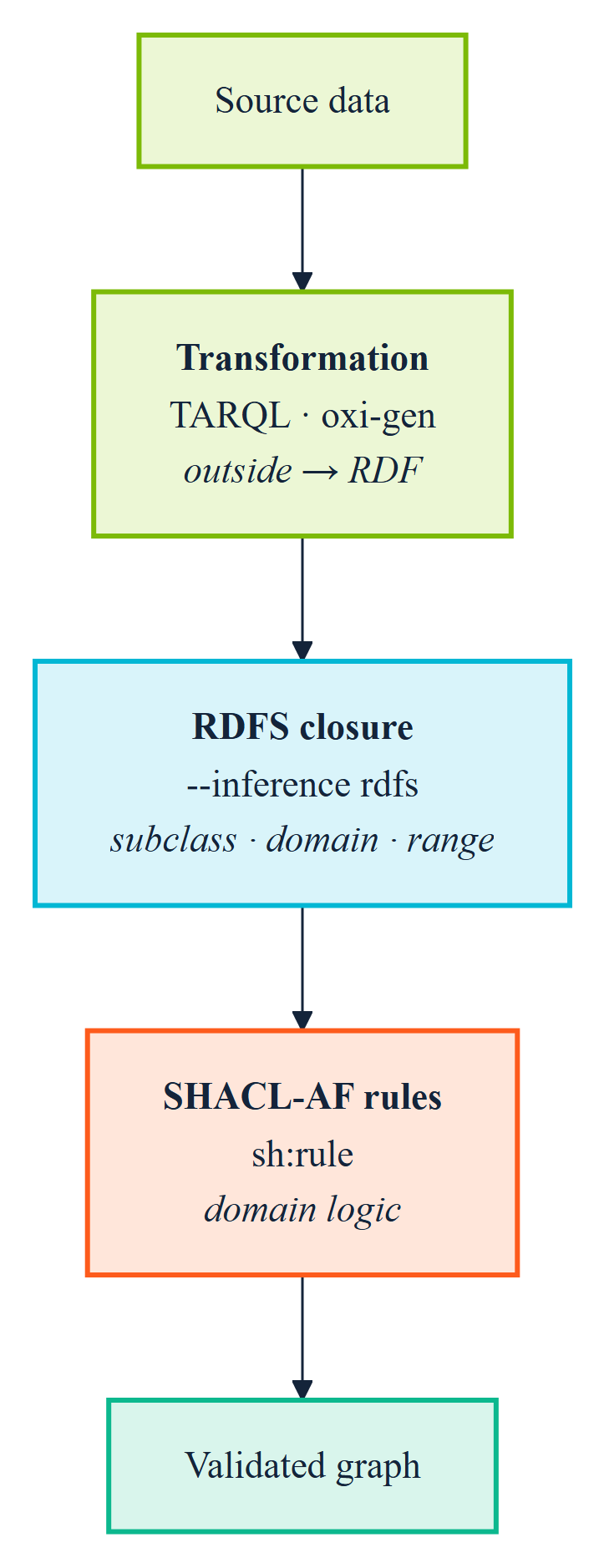
| Mechanism | Use it when | Chapter |
|---|---|---|
| Transformation (TARQL / oxi-gen) | The data is not RDF yet. One row in, some triples out | 10 |
RDFS closure (--inference rdfs) |
You need rdfs:subClassOf/subPropertyOf/domain/range entailments, and nothing more |
This chapter |
SHACL-AF rules (sh:rule) |
The derivation is domain logic — conditional, computed, or specific to your model | This chapter |
The distinction that matters in practice: a transformation runs once, at ingest, and its output is what you store. A rule runs at validation time, and its output may never be stored at all. If downstream consumers need the derived triples, a rule alone does not give them to you — you need to materialise and load them.
Why RDFS closure is not optional trivia
SHACL follows rdfs:subClassOf when deciding class membership, and nothing else. A shape targeting ex:parent via sh:targetSubjectsOf will not see a subject that only has ex:father, however clearly rdfs:subPropertyOf says one implies the other. Materialising the closure first closes that gap:
shacl -d data.ttl -s shapes.ttl --inference rdfsIt covers rdfs2, rdfs3, rdfs5, rdfs7, rdfs9 and rdfs11 — domain, range, both hierarchies and their transitivity. The axiomatic and reflexive rules are deliberately left out: they entail rdf:type rdfs:Resource for every term, which no shape is improved by.
It is off by default because it changes the report — and a sh:closed shape in particular starts seeing inferred predicates and failing on them.
11.3 Triple rules
sh:subject, sh:predicate and sh:object are node expressions evaluated per focus node. Applied to the Acme fixture, the two most common shapes a rule takes:
acme:PersonRules a sh:NodeShape ;
    sh:targetClass acme:Employee ;

    # 1. Constant object: every Employee is also a foaf:Agent
    sh:rule [ a sh:TripleRule ;
        sh:subject sh:this ; sh:predicate rdf:type ; sh:object foaf:Agent ] ;

    # 2. Path object: one triple per value found
    sh:rule [ a sh:TripleRule ;
        sh:subject sh:this ; sh:predicate acme:colleague ;
        sh:object [ sh:path acme:worksIn/^acme:worksIn ] ] .
Rules are off by default and enabled with -a:
shacl -d data.ttl -s shapes.ttl --advancedThe inferred triples are the cross product of the three expressions. A path yielding three values yields three triples — which is what you want for rule 2 and worth remembering before writing a rule whose subject expression is also a path.
The node expressions available are SHACL-AF's: sh:this, a constant, [ sh:path P ] with an optional sh:nodes operand, [ sh:filterShape S ; sh:nodes N ], sh:union and sh:intersection. Anything else is an error rather than an empty result — see §11.7.
Verified behaviour
Running a rule that types every ex:Person as ex:Party, then validating the inferred ex:Party instances against a shape requiring a property none of them have, gives exactly one violation per source instance — 1,000 violations on the 1,000-instance dataset and 100,000 on the 100,000-instance one. Every focus node, once each, no misses and no duplicates.
That is the check worth copying: validate the derived data, so a rule that silently does nothing shows up as a missing violation rather than as silence.
11.4 SPARQL rules
sh:construct takes a CONSTRUCT query with $this pre-bound to the focus node. This is where computation lives:
acme:BoxRules a sh:NodeShape ;
    sh:targetClass acme:Box ;
    sh:rule [ a sh:SPARQLRule ; sh:construct """
        PREFIX acme: <https://acme.example.org/ns/>
        CONSTRUCT { $this acme:area ?a }
        WHERE { $this acme:width ?w ; acme:height ?h . BIND(?w * ?h AS ?a) }""" ] .
Verified: with width 3 and height 4, a shape asserting sh:path acme:area ; sh:hasValue 12 conforms — the arithmetic runs and the derived value is what validation sees.
Prefixes can come from an inline PREFIX line, as above, or from SHACL's own sh:declare/sh:prefixes mechanism:
acme: sh:declare [ sh:prefix "acme" ;
                   sh:namespace "https://acme.example.org/ns/"^^xsd:anyURI ] .

acme:Rules a sh:NodeShape ; sh:targetClass acme:Thing ;
    sh:rule [ a sh:SPARQLRule ; sh:prefixes acme: ;
              sh:construct """CONSTRUCT { $this acme:tagged true } WHERE { }""" ] .
Both forms work, and a rule that omits sh:prefixes entirely now falls back to the shapes graph's own sh:declare — which is how the W3C 1.2 rules corpus writes them.
Fixed in 0.1.8; broken before it. At 0.1.7 a rule relying on a shapes-graph-level
sh:declarealone was not resolved, and the engine rejected the whole shapes graph with a SPARQL prefix error at compile time, whether or not-awas passed — so a document that had validated fine before rules existed stopped validating at all. Rule compile errors are now held on the rule and raised only if that rule would have fired, which means validation that never asked for rules is unaffected and a broken rule is still not silently skipped. Another reason to checkshacl --version.
11.5 Four ways to get a wrong answer
These produce silence, not errors. Every one reproduces exactly as described.
A rule fires on its shape's targets, so a shape with no target does nothing. This is the most common mistake, because attaching a rule to a nested property shape reads perfectly naturally:
acme:S a sh:NodeShape ; sh:targetClass acme:Employee ;
    sh:property [ sh:path acme:name ;
        sh:rule [ … ] ] .        # never fires: this shape has no target
Verified: the rule never runs, nothing is inferred, and no message says so.
One pass, so a transitive rule does not close. SHACL-AF defines a single iteration. A rule deriving ex:sub from two hops of ex:sub reaches two hops and stops. On a chain a→b→c→d, one pass leaves a short of d:
shacl -d data.ttl -s shapes.ttl -a                    # one pass  -> a does not reach d
shacl -d data.ttl -s shapes.ttl -a --iterate-rules 10 # fixpoint  -> it does
--iterate-rules is outside the specification. A rule set with no fixpoint — one minting a fresh term each round — stops with an error rather than running until memory does.
Rules at the same sh:order cannot see each other's inferences. Two rules both at the default order 0 each see the graph as it was before either ran. Verified with a two-step chain (Person → Step1 → Step2): at equal order, Step2 is never reached; with --iterate-rules 5, it is. Give the consumer a higher sh:order, or iterate.
Negation is not monotonic, and iteration exposes it. A conclusion drawn from absence outlives the absence, because rules only ever add triples:
# Round 1 marks ex:a as Unnamed. Round 2's rule then gives it a name.
# The mark stays. It is simply no longer true.
SHACL 1.2 Rules answers this by requiring a stratified rule set; SHACL-AF does not, so it is the author's problem. If a rule tests for absence, either keep to a single pass or ensure nothing later supplies what it tested for.
And one that is not a hazard: rules never modify the graph you passed in. The expanded graph is a new one, so a report is always relative to an input you still have.
11.6 Rules at scale
Measured on this manual's own benchmark data, whole-process wall time, two rules (one triple rule, one SPARQL rule) plus validation of the derived triples:
| instances | triples | validate only | rules + validate |
|---|---|---|---|
| 1,000 | ~6,900 | — | 0.9s |
| 10,000 | ~69,000 | — | 1.1s |
| 100,000 | ~690,000 | 2.7s | 11.9s |
100,000, --iterate-rules 5 |
~690,000 | — | 18.7s |
Rules cost roughly 4.5× validation alone at 100k, and iterating to five rounds roughly 7×. In absolute terms that is twelve seconds to derive and validate over two-thirds of a million triples, which is comfortably inside a CI budget.
For context on the validation half, the same engine against pySHACL on the same data, with identical result counts at every size:
| instances | ours | pySHACL | speedup |
|---|---|---|---|
| 1,000 | 0.040s | 2.992s | 75× |
| 10,000 | 0.199s | 24.369s | 122× |
| 100,000 | 1.808s | 206.250s | 114× |
Two caveats the engine is candid about, and which matter more than the ratio. Loading dominates — at 100k, validation is 0.46s of the 1.81s total, so the first place to look for speed is the parser, not the validator. And the index holds the graph three times over, once per permutation, with no streaming path: budget roughly 3 × 12 bytes per triple plus the interned strings, and do not reach for this on a graph too large to hold three sorted copies of.
The WebAssembly build has a different cost model
Those figures are the native binary. The same engine compiled to WebAssembly — what the editor runs, and what a browser would — behaves differently at size, because wasm32 has a single linear memory that memory.grow may have to relocate, copying the whole heap.
Measured on the engine's own scale probe, one compiled shapes graph against growing data:
| instances | triples | first run | second run | resident |
|---|---|---|---|---|
| 1,000 | 4,000 | 56 ms | 26 ms | 89 MB |
| 10,000 | 40,000 | 205 ms | 137 ms | 76 MB |
| 100,000 | 400,000 | 12,611 ms | 3,119 ms | 329 MB |
At ontology scale — hundreds to low thousands of triples, which is what an editor validates — the difference is noise. At 400,000 triples the first run costs four times the second, and roughly nine of those twelve seconds are the heap being built rather than the graph being checked.
Two consequences:
- Reuse the compiled validator. A caller that validates one document per process pays the growth cost every time; one that holds a
Validatorand validates many pays it once. The API is shaped for the second, and the difference is the table above. - WebAssembly is not a drop-in for bulk data. Editor validation, browser validation, a partner checking their own submission — all fine. A nightly pass over a production graph belongs on the native binary. This does not contradict §11.6's numbers; it says which build they apply to.
11.7 What is not there
Stated plainly, because a rule engine's gaps are where the silent wrong answers live.
| Not implemented | Consequence |
|---|---|
SHACL functions (sh:SPARQLFunction) |
A rule calling one errors — unsupported node expression, exit 2 — rather than returning empty |
Result annotations (sh:resultAnnotation) |
Extra properties from a SPARQL constraint's solution are not copied onto results |
SHACL 1.2 Rules (RULE { } WHERE { }) |
A different design from SHACL-AF; its test corpus ships with the engine but is not wired into the conformance harness |
| OWL-RL pre-inference | RDFS is available and opt-in; nothing beyond it |
| Rules in the VS Code extension | The engine supports them; the extension does not yet ask for them — see below |
Rules in the browser: the engine can, the editor does not
Every binding runs rules — CLI, Python and WebAssembly alike — through the same inference modes:
import { Validator } from 'shacl-wasm';
const v = Validator.fromTurtle(shapesTurtle);
const report = v.validateTurtle(dataTurtle, null, 'rules');   // or 'rules-iterated'
Verified against the built package at 0.1.9: "rules" fires the rule and the derived data is validated, while an unrecognised mode is an error rather than a silent fallback to "none" — which is the failure behaviour that matters, because a browser quietly validating without applying rules would report conformance it never established.
This is recent, and the manual said the opposite one version ago. At 0.1.7 the WASM API exposed
"none"and"rdfs"only. Worse, a shapes graph whose SPARQL rule the native engine rejected at compile time returnedconforms = truefrom WASM — "this is fine" against "I could not check this", which is the distinction Chapter 4 argues everything rests on. Both the missing modes and the divergence are fixed: the engine's differential harness now reports 0 disagreements across all 473 documents of the W3C corpus, where it previously reported one.
What has not changed is the editor. The VS Code extension bundles the 0.1.9 engine, so the capability is present, but its runner asks for inference: "none" deliberately — the reasoning being that inference belongs to the reasoner tier, and a SHACL finding should be about what the document says rather than what a second pass added underneath it. That is a defensible position and the manual does not argue with it; it just means rules in your shapes do not fire in the editor today. Use the CLI or the Python binding for anything rule-bearing, and expect the editor's report to differ from CI's when rules are in play.
Named graphs are flattened
Worth repeating here because rules make it sharper: quad syntaxes parse, and then every named graph and the default graph are merged into one before validation. A rule's inferences are not attributed to any graph. See Chapter 13 §13.1.
11.8 Rules are a governed artefact
Everything Chapter 12 says about ontology change applies to rules, with one addition: a rule change alters the meaning of data you have already validated. Adding a rule that types every Employee as an Agent retroactively brings every Agent shape to bear on your whole employee table.
Four practices:
- Version rules with the shapes, in the same repository. They are not configuration.
- Pin
--advancedand--iterate-rulesin CI, exactly as Chapter 9 pins--engine. Same commit, same answer, on every machine. - Validate the derived triples, not just the source. A rule that stops firing is invisible unless something downstream asserts it should have.
- Treat
--iterate-rules > 1as a deliberate, documented decision. It is outside the specification, so another SHACL processor will not reproduce your results.
Exit codes make this gateable
0   conforms
1   violations found
2   could not validate  (bad input, unsupported feature, compile error)
Verified across all three. That separation is what lets a CI job distinguish "the data is wrong" from "the rules did not compile" — and a job that treats them the same will eventually go green on a rule set that never ran.
Run it: notebook 2 — Rules and inference runs every rule form above and reproduces all four silent-failure hazards.
11.9 Maturity checkpoint
Rules run in CI, versioned alongside the shapes, with derived triples validated and the flags pinned, is most of SemOps element 4 — Reasoning & Inference Operations. It is the element Chapter 14 previously marked partial on the strength of the suite's owlrl closure and reasoner checks alone.
What is still missing at Level 4 scale: incremental reasoning — every run here is a full pass — and performance monitoring of inference jobs. Both remain genuine gaps.