 The SemOps Manual
3. Across the boundary: peers and supply chains
Part I — Why this is hard
Everything in Chapter 2 assumed a shared employer: one budget, one CI system, and — ultimately — someone senior enough to settle an argument. Cross out those three assumptions and you have the cross-enterprise case, which is where semantic technology is simultaneously most valuable and most likely to fail.
It is most valuable because shared meaning across organisations cannot be achieved by a shared database — nobody will accept one. It is most likely to fail because every enforcement mechanism SemOps relies on stops at the company boundary. You cannot fail someone else's build.
3.1 What changes at the boundary
| Inside one enterprise | Across enterprises |
|---|---|
| One CI system can gate every change | You cannot gate a partner's pipeline; you can only detect and notify |
| A senior owner can settle a definition dispute | No shared authority — disputes are settled by negotiation or by power |
| Breaking changes can be fixed downstream by the same team | Downstream is someone else's backlog, with its own priorities |
| Cost of coordination is internal overhead | Cost of coordination is a commercial term someone must agree to pay |
| Sharing a model is uncontroversial | A model can reveal commercially sensitive structure |
| Capability is roughly uniform | Partners range from a semantics team to a spreadsheet and one IT contractor |
The last row is the one most often missed, and it dominates supply-chain work.
3.2 Three topologies, three different problems
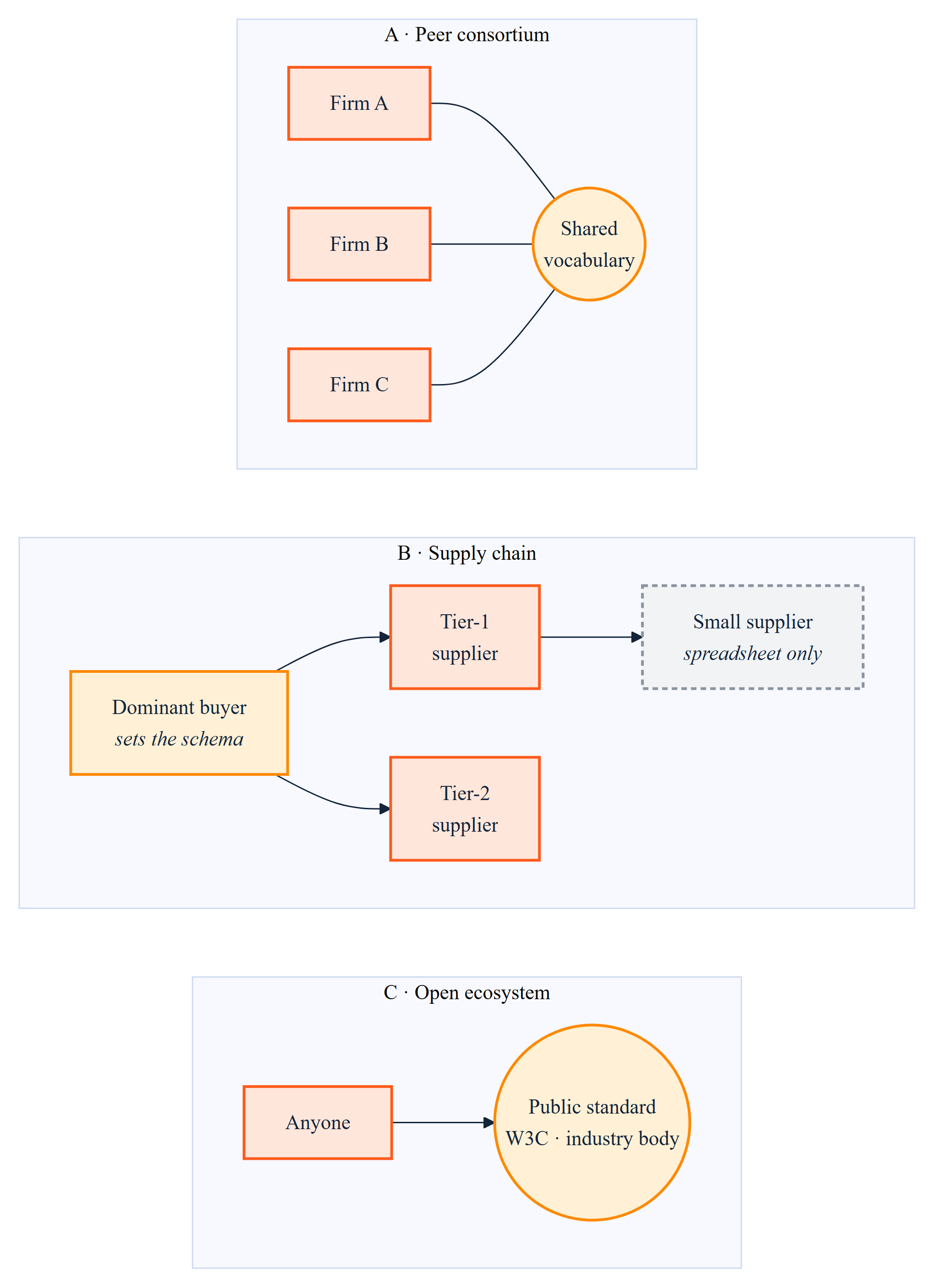
A. Peer consortium — the coordination problem
Competitors or near-peers agree a shared vocabulary: trade associations, regulatory reporting groups, interbank messaging, research consortia.
The hard parts are not technical:
- Nobody can compel anyone. Progress is by consensus, which means the model drifts towards the union of everyone's requirements and the intersection of everyone's willingness to constrain. Consortium ontologies are characteristically under-constrained — everything is optional, because making anything mandatory requires unanimity.
- Commercial sensitivity has a modelling shadow. How you model your customer segmentation reveals your customer segmentation. Members will decline to model the very areas where alignment would be most valuable, and will not always say that is why.
- Competition-law caution is real and worth taking seriously rather than routing around. Legal review of a shared model in a concentrated market is a legitimate step, not obstruction.
- Release cadence is set by the slowest member, because a change nobody has implemented is not a change.
What works: a deliberately small mandatory core, with extension points. Publish the core with real constraints; let each member extend in their own namespace. This is exactly the pattern Part III uses at company scale — import the shared vocabulary, own your extensions, and check only what you own (Chapter 9).
B. Supply chain — the capability-asymmetry problem
One organisation has the leverage to mandate a schema — a large manufacturer, a retailer, a public body. Compliance is a condition of doing business, so adoption is not the problem.
The problems are:
- Capability asymmetry. A tier-1 supplier may have a data team. Their sub-supplier has a spreadsheet and a part-time IT contractor. A mandate that assumes RDF fluency does not produce compliance; it produces a cottage industry of consultants filling in forms on suppliers' behalf, and the data quality that implies.
- The mandate arrives without the tooling. "Send us this in the standard format" is not an ask, it is a project — and the cost lands on the party least able to absorb it.
- Verification is one-directional. The buyer validates what arrives. The supplier gets a rejection with no way to test in advance, so the loop is: send, get rejected, guess, resend.
What works: give the supplier the gate. The single highest-leverage intervention in supply-chain semantics is publishing the validation as something the supplier can run themselves, before submitting. Concretely, from Part III's toolchain:
- Publish your SHACL shapes and check registry as files, not as prose in a PDF. The suite reads a registry directory from
--registry/--shapes/--sparql, so a shared registry is a distributable artefact (Chapter 8). - Accept CSV. Most of the supply chain has CSV, and the CSV→RDF path (Chapter 10) means the supplier never has to author RDF at all — they produce the tabular extract they already have, and the transformation is yours to own and version.
- Ship the check as an editor experience, not a batch report. The VS Code extension runs its checks in-process via WASM, with no Python or Java runtime required — which for a small supplier is the difference between "we can run this" and "we need to procure something."
That last point deserves emphasis: the runtime dependency is a governance decision. Mandating a validation step that requires a JVM excludes a class of suppliers from self-service compliance as surely as mandating a language they do not speak.
C. Open ecosystem — the stability problem
You depend on a public vocabulary you do not control: FOAF, the W3C Organization Ontology, schema.org, an industry standard.
Here the risk inverts. You are not coordinating; you are exposed. The vocabulary may change, stagnate, or turn out to encode conventions that break your tooling in ways nobody documented.
Part III contains a verified, live example of exactly this. FOAF deliberately declares foaf:name with rdfs:domain owl:Thing — an intentional "usable on anything" convention. A conformance checker that walks asserted rdfs:subClassOf edges does not know that every class is implicitly a subtype of owl:Thing under OWL semantics, because that is an axiomatic fact rather than an ordinary triple. The result is a domain/range "violation" on every single foaf:name triple in otherwise perfect data (Chapter 10).
Nobody is at fault. FOAF is behaving as designed, the checker is behaving as designed, and the finding is still wrong. Depending on a public vocabulary means inheriting its conventions, including the ones that were never written down. Budget for discovering them the hard way.
3.3 The cross-boundary release problem
Inside one enterprise, a breaking ontology change is manageable: detect it, find the affected queries, fix them, ship together (Chapter 12 does all three, and the last one automatically).
Across a boundary, the same change is a negotiation with a lead time. You cannot auto-repair a partner's queries; you often do not know they exist.
The protocol that works looks like this:
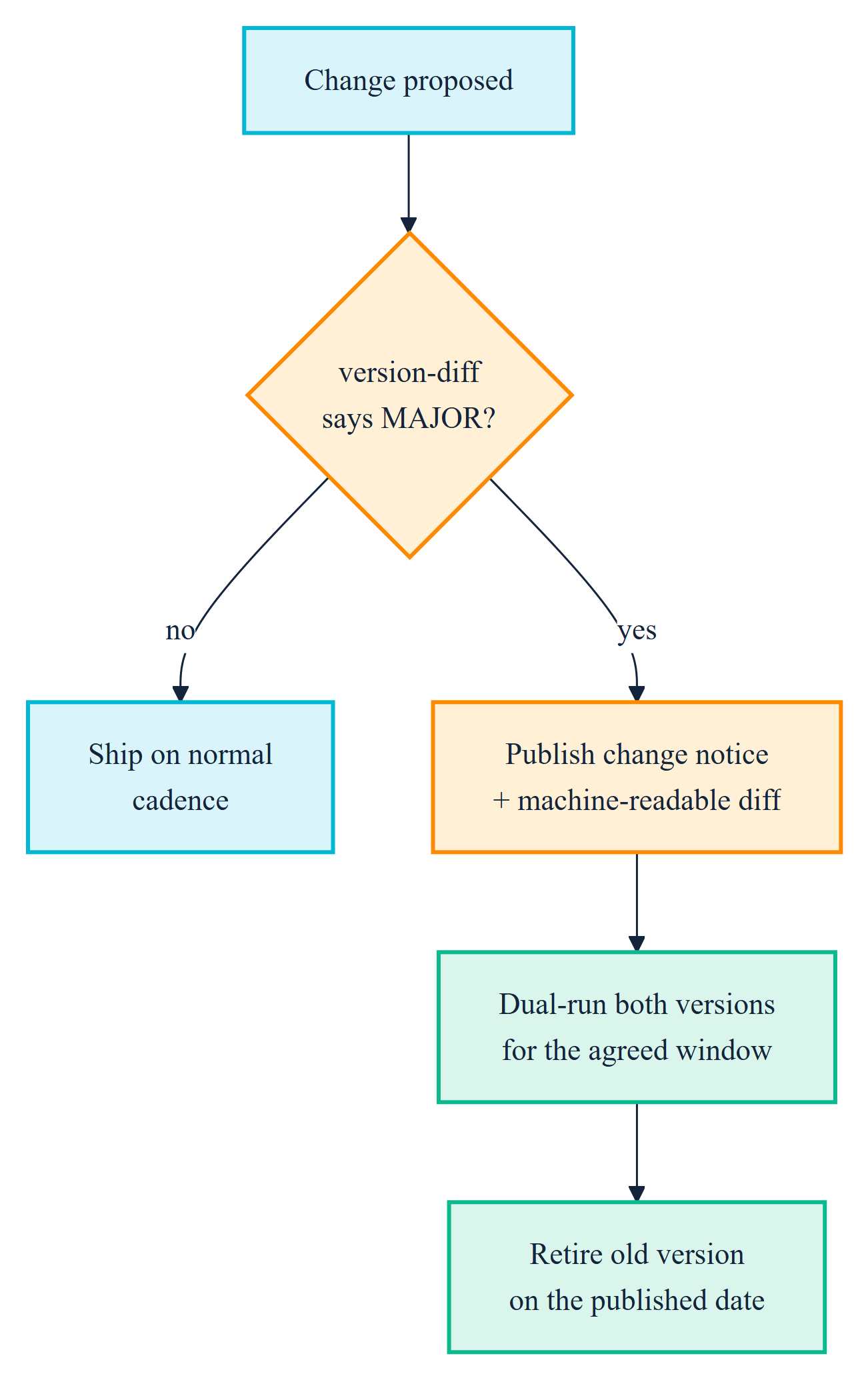
Two things make this workable rather than aspirational:
The bump decision must be evidence-based, not a judgement call. version-diff classifies a change by inspecting what actually happened to the axioms — a removed class is MAJOR whatever the author intended. In Chapter 12 it correctly returns MAJOR for the fixture's release, on the evidence of one removed class, while still reporting the additive changes as minor. Across a boundary this matters enormously, because "is this breaking?" stops being a conversation and becomes a command whose output both parties can run.
The change notice should carry the machine-readable diff, not just prose. version-diff --json writes diff.json alongside the human-readable text. A partner can then diff programmatically rather than reading your release notes and hoping.
Migration annotations are a cross-boundary contract
When you rename a term, assert the migration annotation from the retiring IRI to the new one:
acme:Engineer owl:equivalentClass acme:SoftwareEngineer .owl:equivalentClass is logically symmetric, so a reasoner treats both directions identically — but rename detection reads it directionally, from the removed term to its replacement. Written the other way round, the tooling falls back to name-similarity guessing and confidence drops sharply.
Inside one company that costs you an afternoon. Across a boundary it is the difference between a partner's tooling automatically identifying the replacement, and a human reading a PDF. Write the annotation in the direction the tools read.
3.4 Trust, provenance and attribution
Once data crosses an organisational boundary, "who said this?" becomes as important as "what does it say?" — and it is a question RDF is unusually well equipped to answer, provided someone decided to answer it.
- Keep each partner's contribution in its own named graph. This is the single decision that most improves cross-enterprise operability, and it is nearly free at ingest time and nearly impossible to retrofit. The suite's live-triplestore checking is named-graph aware precisely because this is the expected topology (Chapter 13). Note the limit: named graphs give you provenance and lifecycle, not scoped validation — SHACL is defined over a single graph and validates the union, so checking one partner's contribution against one partner's contract means extracting that graph and validating it on its own (Chapter 13 §13.1).
- Do not merge on ingest. A merged graph cannot answer "which supplier asserted this?", and that is the question the incident review will ask.
- Record the conformance verdict, not just the data. "This batch passed the agreed shapes at version 2.1 on this date" is the artefact that resolves disputes.
3.5 Where this leaves the practice
The cross-boundary case does not need a different toolchain. It needs the same toolchain with three shifts of emphasis:
| Inside | Across |
|---|---|
| The gate fails the build | The gate produces a notice the other party can act on |
| Repairs are applied automatically | Repairs are published as patches for the other party to apply |
| Ownership is a role | Ownership is a contract term |
| Checks scoped to what we own | Checks scoped to what we own and published so partners can run them too |
The right-hand column is mostly a matter of who receives the output, which is why the mechanics in Part III transfer largely unchanged. The failure mode is assuming the left-hand column's enforcement model still applies — building a beautiful gate, and discovering it has no jurisdiction.