 The SemOps Manual
7. The toolchain
Part II — The SemOps frame
Two tools, and one architectural idea that matters more than either of them.
| Ontology Quality Suite | Ontology Development Suite | |
|---|---|---|
| Repository | pwin/consolidated-ontology-quality-suite-python | pwin/consolidated-ontology-quality-suite-webapp |
| Distribution | PyPI: ontology-quality-suite |
.vsix from the latest release |
| Form | Python CLI + importable library | VS Code extension |
| Runtime | Python; optional Java for DL reasoning | In-process WASM/JS — no Python or Java needed |
| Belongs in | CI, release control, pipelines, scheduled jobs | The author's editor, before anything is committed |
| SemOps stages | 3, 6, 7, and the release parts of 1 | 1, 2 |
| Answers | "Does this pass?" | "What did I just do?" |
Versions this edition was measured against. Every number in Part III comes from running these:
Version From Ontology Quality Suite 0.14.2 PyPI ontology-quality-suiteOntology Development Suite 0.13.6 .vsixfrom the repository's releasesSHACL Engine 0.2.0 PyPI shacl; npmshacl-wasm,shacl-wasm-nodeThese move quickly, and the counts in Chapter 9 in particular depend on how many checks the registry holds — 61 at the time of writing, up from 50 two editions ago. Expect your own numbers to differ if your versions do, and see §9.2 on why that is a reason to pin them rather than a reason to distrust the figures.
7.1 The idea: one registry, two runtimes
The suite's quality rules are not code. They are data — a registry.json plus a directory of SPARQL .rq files and SHACL .ttl shape files. The Python CLI reads that data and evaluates it with pySHACL, a native Rust engine, and rdflib. The VS Code extension reads the same data, copied into its own resources/checks-registry/, and evaluates it with Oxigraph compiled to WASM, the same Rust SHACL engine compiled to WebAssembly, and the EYE reasoner.
The two runtimes recently converged. Until version 0.10.0 the extension used a JavaScript SHACL implementation. It now runs
shacl-wasm-node— a WebAssembly build of the same Rust engine the CLI uses natively. On the extension's own workload, all six registry shape files against its bundled ontology, the swap took 71,237 ms down to 324 ms with identical findings and severities, and fixed two shape files that had been crashing outright, soDAT-001andEFF-002could never fire through the SHACL path at all.That makes the claim below stronger than it was: the rule that fails your build is not merely the same data as the rule that underlined the problem in your editor, it is now the same engine evaluating it.
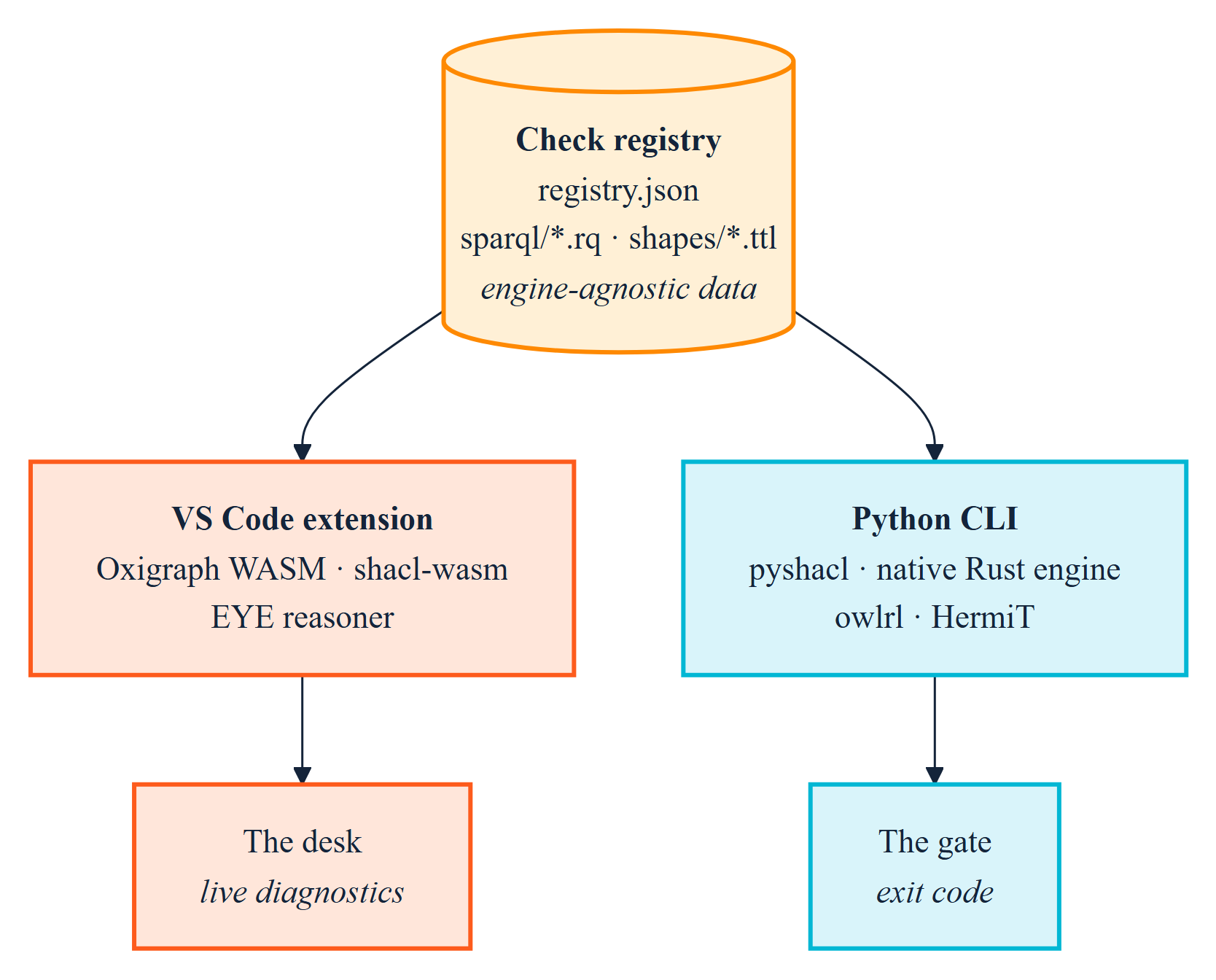
The consequence is the thing to hold on to:
The rule that fails your build is the same rule that underlined the problem in your editor twenty minutes earlier.
That property is worth more than any individual feature in either tool — and it holds for forty-seven of the sixty-one checks, with the fourteen exceptions named further down rather than left for you to discover. Read the claim as the default and the exceptions as the specification. A team whose local linting disagrees with its CI develops a learned distrust of both — green locally, red in CI, and the gate becomes something to be worked around rather than something that helps. Sharing the rules as data rather than reimplementing them twice is what prevents that.
It also means a project-specific check written once (Chapter 8) is available to both, which is how house rules stop being a wiki page nobody reads.
Shared does not mean identical. The extension carries an exact copy of the 61-check registry — same ids, same ten categories — and then adds three of its own with no CLI equivalent: MDL-001/002/003, gist-informed modelling-guidance checks. So the editor can flag something CI will not. That is the right way round — advice belongs where the author is, and a build gate should not fail on a matter of modelling taste — but it is worth knowing before someone asks why a warning they saw while typing never appears in the pipeline.
And being in the registry is not the same as being runnable. This is the distinction that matters most for reading registry.json, and an earlier edition of this manual got it wrong. VOC-001, the closed-world vocabulary check in Chapter 8, moved out of the extension's private extras into the shared registry — and this manual reported that as "so CI runs it too". It does not. Verified directly: a graph asserting acme:bob a acme:Empolyee against a CLI run produces eleven findings and VOC-001 is not among them, because nothing in the Python package implements it. Only registry.json mentions the id.
What moving into the registry actually bought is worth understanding, because it is a real gain and a smaller one than "both sides run it". The registry is the shared vocabulary of findings: id, title, severity, category, remediation text. The extension can be pointed at a checkout of the CLI's registry, so an id it emits must be declared there too, or the finding arrives with no title and no severity but whatever the emitting code hardcoded. Being declared makes a finding nameable by both sides. Being implemented makes it producible by one.
Neither side runs all sixty-one. Three are the extension's alone — VOC-001, REA-005 and REA-006, on top of the three MDL checks that are not in the registry at all — and eleven are the CLI's: REA-020/021/022 need a full DL reasoner, REA-010/011/012 are OWL2 profile membership the extension computes but does not report as findings, CNF-001/002/005 need a two-graph split the editor does not have, and TQL-004/005 read a graph only the CLI builds.
Both repositories pin their own exception list, and each names the other's. That is the part to copy. A shared registry with no such list is a promise the UI does not keep: a reader opening registry.json has no way to tell which entries can ever fire, and a check that cannot fire is indistinguishable from a check that found nothing. Publishing the rules is the easy half; publishing what your implementation actually does with them is the half that makes the rules trustworthy across an organisational boundary (Chapter 3).
Shared data is not shared behaviour, and only one of them is cheap to pin. The registry travels as data, so a test can compare the two copies character for character — and one does. But not everything the two tools have in common is data. A handful of algorithms are written twice, once in Python and once in TypeScript, and those are invisible to a test that compares files.
The one that proved it decides which text a tool is allowed to rewrite: strip_comments in the CLI, behind --apply-repairs; stripComments in the extension, behind rename, find-references and go-to-definition. Both shipped the same defect for the same reason — a scan that skipped a line beginning with # but read a trailing comment in full — so this line
ex:Dog a owl:Class . # was ex:Dgo, renamed 2026-09-04recorded an occurrence of ex:Dgo inside the remark. Rename it and the note explaining the rename was itself rewritten, turning a true comment into a false one, and find-references counted every prose mention of a term as a use of it. Both sides were fixed in the same week, independently, in two languages, and nothing noticed they had been wrong together. That coincidence is the clearest evidence available that nothing was comparing them.
The existing parity test could never have caught it, and the reason is worth sitting with: it compares the registry, the shapes, the queries and the repair templates — shared data. Two hand-written ports of one algorithm are shared behaviour, and the property that matters is the one nothing checked: given the same text, both must blank the same characters. A rename that is safe through one tool would be unsafe through the other, silently.
The fix is a fixture of sixteen cases that both repositories carry. Each side runs its own port against its own copy, so the suite still works on a machine with one checkout, and a final test compares the two copies for whoever has both — precisely the person who is in a position to make them disagree. The cases are hand-written rather than generated from either implementation, which is the detail that makes it work: a fixture derived from the code only restates what the code already does, and would have agreed with both ports on the day they were both wrong.
Verified here with both checkouts present: the two copies are identical as parsed JSON, the Python port passes all sixteen, and every expected output is the same length as its input — because comments are blanked to spaces rather than removed, so an offset found in the mask still indexes the real document.
The generalisation is not about these two tools. Wherever one rule has two runtimes — and that is the normal condition for anything shared across a supply chain (Chapter 3) — sort what you share into data and behaviour. The data is easy: publish it, and compare copies. The behaviour is the part that drifts, and the only defence is a fixture written from the intent rather than from either implementation. A conformance suite that a vendor generates from their own product tells you nothing about whether they agree with anyone else.
7.2 Installing them
The Python suite
PyPI · source · requires Python 3.11+
pip install ontology-quality-suiteor, working from a checkout:
uv sync                        # base install
uv sync --extra reasoner       # + owlready2 for real OWL2 DL reasoning (needs Java)
The reasoner extra is optional by design, and Chapter 4 explains why that design matters. Without it you still get the always-on owlrl closure and pattern checks, which catch the fixture's deliberate contradiction on their own — you also get an explicit REA-022 finding telling you the DL reasoner did not run and what that means for completeness. You are never silently under-checked.
Two invocation styles appear in this manual:
ontology-quality-suite <command> ...        # installed entry point
python -m ontology_suite <command> ...      # module form, from a checkout
They are equivalent. The module form is used in Part III because that is how the commands were actually run while writing it.
The VS Code extension
It is not on the Marketplace, so download the .vsix from the release — not from the repository tree, which carries older builds alongside the current one — and install it with Extensions: Install from VSIX… in the command palette, or:
code --install-extension ontology-dev-suite-<version>.vsixCore functionality — authoring, live diagnostics, local checks, metrics, graph view, query workbench — has no external runtime dependency at all: Oxigraph, shacl-wasm and eyereasoner are WebAssembly or pure JS.
The Python CLI is detected via the ontologySuite.pythonCliPath setting or on PATH, and is used only for the two commands that genuinely need it — Run Deep Validation (full OWL2 DL reasoning) and Run Full Triplify (the real oxi-gen binary). Both degrade gracefully when it is absent.
That zero-dependency property is a governance fact, not just a convenience. As Chapter 3 argues, a validation step that requires a JVM excludes a class of supply-chain partners from self-service compliance.
7.3 Decision table: question → command
| You want to… | Run | Chapter |
|---|---|---|
| Know if the ontology itself is sound — no data | ontology |
8 |
| Run the full registry against ontology and/or data | checks |
8, 9 |
| See only findings in terms you own | checks --own-namespace <IRI prefix> |
9 |
| Check CSV→RDF queries against the ontology, no CSV needed | sketch |
10 |
| Actually produce RDF from CSV | triplify |
10 |
| Assess real triplified data | data |
10 |
| Compare two versions, get MAJOR/MINOR/PATCH | version-diff |
12 |
| Find and auto-repair ontology↔︎query drift | consistency |
12 |
| Check a controlled-vocabulary layer too | pattern-consistency |
12 |
| Run the checks against a live triplestore | consistency-remote |
13 |
| Produce something a stakeholder can read | docgen |
13 |
| Run everything applicable, one report | run |
9 |
And the editor-side equivalents, by VS Code command:
| You want to… | Command |
|---|---|
| Start a new ontology with imports wired up | New Ontology |
| Add a class in the right place in the hierarchy | Add Class or Category / Add Subclass / Add Sibling Class |
| Run the registry locally, in-process | Run Local Checks |
| See the model as a picture | Visualize Subject Graph |
| Draft an ontology and query from a raw CSV | Infer Ontology + Query from CSV |
| Preview a transformation against sample rows | Query Workbench |
| See DL expressivity and OWL2 profile membership | Show Metrics & DL Expressivity |
| Escalate to full OWL2 DL reasoning | Run Deep Validation |
7.4 Two flags worth knowing before you start
--engine
checks, data and run accept --engine. It defaults to native+sparql when the optional Rust SHACL engine is installed, and both (pyshacl) otherwise.
Most documentation treats this as a speed switch. It is mostly that now, but it was not always, and the history is instructive. All four modes, run against this manual's fixture with --own-namespace, same ontology, same registry:
--engine |
Findings | Severity split | What it runs |
|---|---|---|---|
native |
4 | 1 V / 3 W | The SHACL shapes only. Misses QUA-004, which exists only as a SPARQL check |
sparql |
5 | 1 V / 4 W | The .rq checks only. The numbers used throughout this manual |
native+sparql |
5 | 1 V / 4 W | Both, deduplicated |
both |
5 | 1 V / 4 W | pyshacl + SPARQL, deduplicated |
Three of those four now agree exactly. One thing still follows, and one piece of history is worth carrying.
Neither formulation is complete alone. The registry is implemented in two formulations — 44 SPARQL .rq files and 6 SHACL shape files — and they do not cover the same checks. --engine native silently misses QUA-004 because that check exists only as SPARQL. Do not use a single-formulation mode expecting full coverage; if you want one, sparql is the one with the broader registry behind it.
The severity lesson is about shape authoring, not about engines. Until recently --engine both reported 5 Violations where native+sparql reported 2 on identical findings, and this manual — along with a long comment in the suite's own source — attributed it to a pyshacl limitation. That was half right. pyshacl does ignore sh:severity in the position it was written, but the position was wrong: the shapes declared it inside each nested sh:sparql [ … ] constraint block, where SHACL defines it as a property of the enclosing shape. The native engine read it there anyway; pyshacl fell back to the spec default of sh:Violation. Moving the declaration onto the shape made both engines agree, and both now match registry.json exactly.
The consequence while it lasted is worth remembering, because it is the failure mode a severity mistake always produces: with
--fail-on Violation, a class namedperson_recordfailed CI exactly as hard as a logical contradiction. If your gate is failing on things you deliberately declaredWarning, check wheresh:severityis attached before blaming the engine.
There is a governance postscript, and it is the more transferable half. Because the registry is shared, the same misplacement existed in the extension — which had built a workaround for it, treating correct engine behaviour as an engine bug. When the fix landed in the suite, the extension did not adopt the findings on trust: it assessed each against its own stack, concluded two did not apply and one applied in a different form, and then deleted its workaround.
Shared artefacts require propagation with independent assessment, not synchronisation. A fix that is right for one runtime is a hypothesis about the other. This is Chapter 3's cross-boundary problem in miniature, inside one organisation.
The speed difference is real too — the suite's architecture documentation records benchmarks up to roughly 665× on a real-sized ontology, and the engine's own harness measures 75–122× against pySHACL across 1k–100k instances with identical result counts at every size.
--verbose
Every subcommand takes -v/--verbose, which prints what each input option actually resolved to before running: which files matched a glob, which owl:imports resolved and from where, which engine ran.
Reach for it whenever a result looks surprising, before assuming a bug. Most "the tool is wrong" reports turn out to be an owl:imports that silently did not resolve, and --verbose shows that in one line. There is a worked instance of exactly this class of mistake in Chapter 9, where an IRI prefix off by one character produced a confidently empty report.
7.5 The fixture used throughout Part III
Every command in Part III runs against examples/acme_robotics/ in the Python suite — a small org chart built on two real, standards-track vocabularies rather than an invented domain:
| Vocabulary | Used for |
|---|---|
W3C Organization Ontology (org:) |
org:OrganizationalUnit as the base class for departments |
FOAF (foaf:) |
foaf:Person as the base for employees; foaf:name, foaf:mbox |
The fixture is deliberately imperfect, with each flaw commented with the check it demonstrates:
| Term | Flaw | Check it triggers |
|---|---|---|
acme:Contractor |
rdfs:subClassOf acme:Employee and owl:disjointWith acme:Employee |
LOG-001 — logically unsatisfiable |
acme:hasSkill |
no rdfs:label, and no skos:prefLabel either |
QUA-001, QUA-004 |
acme:reports_to |
local name is not lowerCamelCase; no domain or range | STY-002, STR-003 |
Each deliberate flaw produces exactly one finding, which is the property that makes the fixture usable as a teaching example: every finding traces to a line someone wrote on purpose.
The scoped run in Chapter 9 reports 23, and the gap is instructive rather than a discrepancy. Eighteen of those 23 are QUA-009 and QUA-010, nine each — a documentation policy the registry asks for (a skos:prefLabel per language, a skos:definition) that this fixture does not follow. That is one decision you have not taken, reported nine times, not nine mistakes — and telling those two things apart is the whole subject of Chapter 9 §9.4.
acme-org-v2.ttl is a plausible next release: it renames acme:Engineer to acme:SoftwareEngineer — a breaking change, with a migration annotation — and adds one genuinely additive class and property. It deliberately leaves the flaws above untouched, because real releases do not fix everything at once.
Using real external vocabularies rather than toy ones is what makes Chapters 9 and 10 possible: the most valuable lessons in this manual come from the collision between a general-purpose checker and the conventions real vocabularies actually use.
7.6 Where the deeper documentation lives
This manual is the SemOps layer. For tool-level depth, the suite's own docs/:
| Document | Covers |
|---|---|
PRIMER.md |
Task-oriented guide, worked examples, CI wiring, adoption path |
CHECKS.md |
All 61 checks, by category |
ARCHITECTURE.md |
Engine comparison, benchmarks, file loading |
REASONING.md |
Reasoner backends and their real limitations |
CONSISTENCY_AND_REPAIR.md |
Finding-kind → fix-kind → confidence table |
EXTENDING.md |
Authoring your own checks |
FUSEKI.md |
Live-triplestore manifest spec and Python API |
VERSIONING.md |
Semver rules for ontologies |
UPDATING.md |
Sequencing and rollback for coordinated rollouts |
ACME_ROBOTICS_WALKTHROUGH.md |
The fixture, end to end, plus two runnable notebooks |
The webapp repository's README.md and TUTORIAL.md do the same for the extension.
There is also a third repository worth knowing about, though you do not install it: consolidated-ontology-quality-suite-python-testing holds thirteen deliberately broken OWL2 ontologies and a harness asserting which registry checks each one must trigger. Its COMMANDS.md gives every fixture as both a harness invocation and the equivalent bare CLI command, which makes it a useful worked reference for the suite in general. Chapter 9 §9.8 is about the practice it demonstrates.