 The SemOps Manual
8. Model and validate
Part III — The practice · SemOps stage 2 · Operating-model layer 2
Stories answered here As an ontology engineer, I want to know whether the change I just typed broke anything, without leaving the editor. As a domain expert who does not read Turtle, I want to check the model matches how the business actually works. As a knowledge engineer, I want our own house rules enforced, not just generic ones.
Stage 2 is where the artefact is written, and it is the stage with the highest leverage per pound spent. A problem caught here costs a keystroke. The same problem caught in CI costs a context switch; caught in production it costs an incident and a meeting.
8.1 The inner loop belongs in the editor
The SemOps pipeline blueprint lists "modelling and local validation" as a stage in its own right, before CI, and this is not a formality. If the only way to find out whether a model is sound is to commit and wait, the feedback loop is minutes long, and a minutes-long loop changes how people work: they batch changes, they commit less often, and they stop experimenting.
The Ontology Development Suite exists to make that loop seconds long. Everything below runs in-process, via WASM, with no Python or Java involved.
Structure you can see
The Ontology Outline renders classes and properties as a nested, Protégé-style hierarchy in the Explorer sidebar — object and datatype properties kept as separate subtrees, rather than one flat list:
▾ Classes (4)
  ▾ Employee
      Contractor
      Engineer
    OrganizationalUnit
▾ Object Properties (2)
    works in
    reports to
▾ Datatype Properties (3)
    has skill
    has employee ID
This is the artefact from Chapter 2 that a domain expert can actually validate. Nobody needs to read an axiom to say "Contractor should not be under Employee — contractors are not on our payroll." The priesthood problem is defeated by rendering, not by training.
Authoring happens in the same tree: right-click any class or property node for Add Subclass, Add Sibling Class (which inherits the sibling's own parents) or Add Sub-property. Dragging one class onto another adds an additional parent — deliberately never a destructive move, and the confirmation message says so.
Live diagnostics, including one SHACL cannot give you
Run Local Checks evaluates 44 SPARQL and 6 SHACL-SPARQL check files from the same 61-check registry the CLI reads — plus OWL2-RL-style inference and contradiction detection, into the standard Problems panel.
It also runs three checks the CLI does not have — MDL-001/002/003, gist-informed modelling-guidance checks (Chapter 7 §7.1). Advice belongs where the author is, so seeing something here that never appears in CI is the design rather than a discrepancy.
VOC-001 below is a fourth of a different kind, and a correction to an earlier edition of this manual, which said it had moved into the shared registry "so CI runs it too". It is in the registry; the CLI still cannot produce it. Only the extension implements it, along with REA-005 and REA-006 — Chapter 7 §7.1 has the distinction between a check being declared and being runnable, which is the one to hold on to when reading registry.json.
Eleven go the other way. The editor cannot produce REA-020/021/022 (they need a full DL reasoner), REA-010/011/012 (OWL2 profile membership, which it computes for the status bar but does not report as findings), CNF-001/002/005 (a graph assessed against a separate ontology, where Run Local Checks merges the document with its imports so there is no "separate" left), or TQL-004/TQL-005 (Chapter 10 §10.2), which query the BIND facts graph the CLI builds from a TARQL query and the editor does not.
Those last two are worth a sentence for the reason they are held back explicitly. The extension's coverage test treats the presence of a .rq file as proof the check runs — true of every other directory — so left alone they would have counted as implemented while being unable to fire, making the exception list assert something false and still pass. A check that cannot fire and a check that found nothing are indistinguishable from the outside: the same hazard as §7.4's silent --own-namespace filter, one layer up.
One check is worth calling out because it addresses a genuine blind spot in SHACL itself. VOC-001, the closed-world vocabulary check, catches the typo:
:bob a acme:Empolyee . # note the transpositionSHACL's open-world semantics will never flag this. Nothing contradicts the existence of an undeclared class — it is simply never asserted to. The graph is valid; it is just about something that does not exist.
VOC-001 walks every triple's predicate and, for a fixed set of term-referencing predicates (rdf:type, rdfs:subClassOf, rdfs:domain, rdfs:range, owl:equivalentClass, sh:targetClass, and others), its object too — flagging any IRI not declared in the document or its resolved imports.
Critically, it is scoped to namespaces the graph has some closed-world knowledge of: at least one term must already be declared there. An external vocabulary that was never actually imported is left alone rather than flooded with false positives, and rdf:/rdfs:/owl:/sh:/skos:/xsd: are excluded automatically. That scoping decision is the same instinct as Chapter 9's central lesson: a check is only useful if its findings are about things you control.
If you want this in CI, ask for STR-001 instead. Since the CLI cannot produce VOC-001, the practical question is what does gate on the typo above, and the answer is the one-graph structural form of the same question. Run against that exact file, the CLI reports eleven findings including STR-001; VOC-001 is not among them. So the typo is caught at the gate — just under a different id and with narrower reach, since VOC-001 also covers the axiom positions. Worth knowing before you write a CI rule naming the id you saw in the editor.
Quick Fix, with the diff shown first
Sixteen checks offer a one-click lightbulb repair, each computed from a real SPARQL Update and completed where relevant by the project's own .ontology-suite/standards.json. Nothing is ever written without an explicit confirmation showing the exact triples that will change.
That confirmation step is not timidity. An auto-fix that silently rewrites an ontology teaches the team not to trust the tool, and one bad silent rewrite costs more confidence than fifty good ones earn.
Refactoring that knows what is a comment
Rename, find-references and go-to-definition work on CURIEs across the document, which is what makes renaming a term a thirty-second operation rather than a careful grep.
All three depend on one decision — which text counts as code — and until 0.13.5 they got it subtly wrong, in a way worth knowing about because it is the same defect the CLI's --apply-repairs carried (Chapter 12), found independently in both. The scan skipped a line whose first non-space character was # but read a trailing comment in full, so
ex:Dog a owl:Class . # was ex:Dgo, renamed 2026-09-04recorded a use of ex:Dgo inside the remark. Renaming rewrote the note that explained the rename; find-references inflated its count by every time anyone had written a term name in prose; and the undeclared-prefix warning, sharing the line of code, flagged # TODO: use foo:Bar. All three now mask comments first, using a scanner that preserves offsets — so a reported column still selects the right characters — and that knows both that # is the fragment separator in almost every RDF namespace, so <http://example.org/ns#Term> survives intact, and that a # inside a literal is not a comment.
CURIEs inside string literals are still scanned, deliberately. A term named in an sh:message or an embedded query is a real reference, and dropping those would make find-references quietly incomplete — a worse failure than the occasional false positive it would save. The CLI arrives at the same behaviour from the opposite direction, because a TARQL IRI template is built out of string literals (Chapter 12 §12.4). One behaviour, two reasons.
A warning that says where it actually looked
Worth one paragraph because the lesson is general. The unresolved-import warning used to read "no workspace file declares this identity or owl:versionIRI". Only the first three words were wrong, and they were the ones a reader acts on: resolution walks the document's own directory tree, never the workspace, so an ontology in a sibling folder produced a warning asserting as fact that it was not there — sending the reader after a file that was present all along, in a folder the resolver never opened.
It now names the directory it searched and how many ontology files it found, which between them separate the two causes an IRI alone cannot: none found, so the location is the thing to check, and nothing was matched against; or candidates, none matching, where the path was right and the real cause is that a file holding the whole vocabulary still cannot satisfy an import without an a owl:Ontology header. A diagnostic should assert only what it checked — the general form of a mistake that is easy to make in your own SHACL messages too.
Metrics and expressivity, live
Show Metrics & DL Expressivity reports OntoQA-style schema metrics — class and property counts, inheritance and relationship richness, hierarchy depth — plus a DL-expressivity label such as ALCHIQ(D) and OWL2 EL/QL/RL profile-membership badges. The expressivity label also sits in the status bar.
The ontology is never restricted to a profile. The display just shows where it currently sits, which lets you develop deliberately in a lighter profile when a downstream consumer needs one — and, more usefully, notice the moment a casual edit pushes you out of it.
Seeing what the reasoner adds
Visualize Subject Graph renders a subject neighbourhood as a real SVG via Graphviz compiled to WASM. Its most instructive toggle is Show inferred (reasoner closure), which runs the EYE reasoner over the neighbourhood and overlays derived triples as dashed edges alongside the asserted graph's solid ones.
For anyone learning what an ontology actually does, this is the single most valuable view in either tool: the difference between what you wrote and what follows from what you wrote, drawn on one picture. It is also the fastest way to discover that a subclass chain you thought was harmless entails something you did not intend.
Competency questions as tests
.cq.rq files — SPARQL ASK/SELECT with expected-result directives — appear in the VS Code Test Explorer and run like unit tests.
This is worth more than it first appears. A competency question is the closest thing ontology work has to a requirement: "can this model answer 'which contractors report to someone in Engineering?'" Making them executable turns a modelling discussion into a regression suite, which is exactly the move Chapter 2 recommends for surviving maintenance fatigue — the expert's requirement, captured once, checked forever.
How the editor behaviour in this section was established. By reading the extension's source and manifest, by its own test suite, and by driving the packaged
.vsixfrom a real install layout — not by working through a live GUI session. The commands, checks and engines named here are verified to exist and to run; the feel of using them is not something this manual has measured. Treat screenshots-in-prose accordingly.
8.2 The tightest CLI loop: ontology
When you want the same judgement from a terminal — or from a script — the narrowest command is ontology: no data, just "is the schema itself sound?"
python -m ontology_suite ontology \
  --ontology examples/acme_robotics/acme-org-v1.ttl \
  --import-dir examples/acme_robotics \
  --out-dir out/ontology
Real output from that command against the fixture:
Findings: 2 total (1 Violation, 0 Warning, 1 Info)
Reports written to: out/ontology
  - out/ontology/report.html (start here)
  - out/ontology/full_results.csv
The two findings:
| ID | Severity | What it found |
|---|---|---|
LOG-001 |
Violation | acme:Contractor is disjoint with its own transitive superclass acme:Employee, making it unsatisfiable |
REA-022 |
Info | The external DL reasoner could not run; only the always-on owlrl closure and pattern checks executed |
LOG-001 is the deliberate contradiction in the fixture, caught without any external reasoner. Its message is worth reading in full, because it is a model of what a check message should be:
Class
https://acme.example.org/ns/Contractoris asserted disjoint with its own (transitive) superclasshttps://acme.example.org/ns/Employee, which makeshttps://acme.example.org/ns/Contractorlogically unsatisfiable.Remediation: Remove either the subclass axiom or the disjointness axiom; the two together are contradictory.
No description-logic background is required to act on that.
REA-022 is Chapter 4's worked example of consuming research-grade components responsibly: the DL reasoner failed, and rather than crashing or — far worse — silently reporting success, the suite emitted a first-class finding naming exactly which checks did not run and what that costs you in completeness.
You may see 3 findings here, not 2. The DL reasoner is intermittently flaky; when it starts,
REA-022is replaced byREA-020(the ontology is inconsistent) andREA-021(acme:Contractoris unsatisfiable), giving three independent confirmations of the same deliberate contradiction. Three runs of this exact command in one session gave the reasoner-working result once and the reasoner-failed result twice. Neither is an error; Chapter 14 §14.4 has the detail.
Want a specific OWL2 profile checked? --profile EL (repeatable). It is off by default; ask for it explicitly when a downstream consumer needs a lighter profile.
8.3 The full registry: checks
ontology is the schema-soundness subset. checks runs the whole 61-check catalogue across ten categories — structural integrity, logical cogency, naming style, documentation, efficiency, data quality and more — against an ontology, a data graph, or both.
python -m ontology_suite checks \
  --ontology examples/acme_robotics/acme-org-v1.ttl \
  --import-dir examples/acme_robotics \
  --engine sparql \
  --out-dir out/checks --fail-on never
Run exactly like that, against the fixture with its real org: and FOAF imports resolved, this reports close to 300 findings — a representative run gave 294 (48 Violations, 162 Warnings, 84 Infos), and the total drifts by a few between identical runs.
Five of those are Acme's. The rest are the registry doing its job thoroughly against the internals of the W3C Organization Ontology and FOAF.
That number is the subject of Chapter 9, and it is the most important practical lesson in this manual. Do not wire this command into CI as written.
8.4 Your own rules, without forking anything
SemOps layer 2 calls for SHACL constraint modelling as an ongoing knowledge- engineering activity, and layer 1 lists "modelling standards" as a core artefact. Both are hollow unless a project's own rules can be enforced as easily as the built-in ones.
The registry is data, so this needs no code. Point the CLI at your own directory:
python -m ontology_suite checks \
  --ontology examples/acme_robotics/acme-org-v1.ttl \
  --data out/triplify/employees.ttl \
  --registry examples/acme_robotics/custom_checks/registry.json \
  --sparql examples/acme_robotics/custom_checks/sparql \
  --engine sparql --out-dir out/acm001
The fixture ships exactly one such check, ACM-001, which encodes an Acme HR requirement no general-purpose registry could know about — every employee must carry a traceable employee ID:
CONSTRUCT {
  _:r a sh:ValidationResult ;
    sh:resultSeverity sh:Violation ;
    sh:focusNode ?this ;
    sh:resultMessage "Employee {$this} has no acme:hasEmployeeId." ;
    sh:sourceConstraintComponent acme:ACM-001 .
}
WHERE {
  ?this a acme:Employee .
  FILTER NOT EXISTS { ?this acme:hasEmployeeId ?id }
}
with a registry entry giving it a title, a category, a default severity, a description and — notably — a remediation string:
{
  "id": "ACM-001",
  "category": "structural",
  "default_severity": "Violation",
  "title": "Employee missing an employee ID",
  "description": "An acme:Employee individual has no acme:hasEmployeeId value -- every employee record must be traceable to Acme's HR system of record.",
  "remediation": "Add acme:hasEmployeeId \"ACM-NNNN\" to the employee, or fix the triplify query/CSV mapping that should have set it.",
  "cucumber_feature": "Acme HR Data Quality",
  "cucumber_scenario": "Every employee record carries a traceable employee ID"
}
Three things about this pattern are worth internalising.
Checks are discovered by walking the directory, not from a manifest list. To remove a check, delete its .rq file; to add one, drop in a file and a registry entry. This makes a project's rule set a normal, reviewable part of the repository.
A minimal registry replaces the defaults. The fixture's registry contains only ACM-001, so running as above runs only that check. To keep the built-in 50 running alongside, point --shapes/--sparql at the installed resources directory as well. Find it with:
python -c "from ontology_suite import config; print(config.PACKAGE_RESOURCES)"Fill in the cucumber fields. They are not decoration: every run writes a cucumber.json in which each check becomes a scenario with a pass/fail status, which most CI systems render natively alongside unit tests (Chapter 9 §9.5). A house rule with those two fields blank still works, and still appears — as an anonymous row nobody outside the team can interpret.
The remediation field is the deliverable. A rule that says "ACM-001 failed" generates a ticket. A rule that says "add acme:hasEmployeeId "ACM-NNNN" to the employee, or fix the triplify query that should have set it" generates a fix. When you write house rules, spend the time on that field — it is where the knowledge actually lives, and it is what makes the check legible to someone who was not in the room when the rule was agreed.
This is also the artefact Chapter 3 recommends publishing to supply-chain partners. A registry directory is a distributable thing: a partner can run your rules before submitting, instead of discovering them through rejection.
The contract a check has to satisfy
ACM-001 above is a CONSTRUCT that builds a sh:ValidationResult. That is the whole interface, and four properties are not optional:
| Property | Why |
|---|---|
sh:resultSeverity |
Decides whether --fail-on Violation stops the build |
sh:focusNode |
What the finding is about; also what --own-namespace filters on |
sh:resultMessage |
What a human reads (Chapter 2) |
sh:sourceConstraintComponent |
The check id, as oq:<ID> — without it the finding cannot be attributed |
Add sh:resultPath and sh:value when there is a natural predicate or offending value. Binding several of either on one result is fine and is often the honest thing to do — a check complaining about two inverse properties should name both. They are sorted and joined, so the finding renders and deduplicates identically however the engine happens to order them. (It did not always: an arbitrary single pick was the cause of the wandering counts in Chapter 9 §9.2.)
Queries must be self-contained — their own PREFIX declarations, no external state — because the runner discovers them by walking the directory and executes each on its own.
Writing the SHACL half too
Most checks in the registry exist twice: once as a .rq file and once as a shape in shapes/<category>.ttl. That is what makes --engine native+sparql corroborate rather than merely combine, and it is worth copying for a check you intend to rely on.
Prefer native SHACL core constraints — sh:minCount, sh:pattern, sh:or, sh:disjoint, property paths — where the check maps onto them cleanly, and fall back to sh:sparql with a sh:select mirroring the .rq file's WHERE clause where it does not. Name the shape oq:<ID> and nothing further is needed to attribute it.
Put
sh:severityon the shape, never inside thesh:sparql [ … ]block. SHACL defines it as a property of the shape. Inside the nested constraint it parses fine, and is then read by some processors and ignored by others — pyshacl substitutessh:Violation— so the same shape yields different severities under different--enginevalues. This is not hypothetical: the suite's own shapes were authored that way, and the result was a class namedperson_recordfailing CI exactly as hard as a logical contradiction (Chapter 7 §7.4).If both formulations exist, they must also agree on
sh:resultPathandsh:value, or the same finding arrives under two dedup keys and is reported twice.
When a graph pattern will not do it
Some conditions cannot be expressed as a pattern over a single merged graph — anything needing arithmetic across the whole graph, or a library call. The suite supports a third form, a native Python check, for exactly those. It is the right escape hatch and the wrong default: a SPARQL check is portable across both engines and readable by anyone who knows SPARQL, and a Python one is neither.
Prove it fires before you trust it
This is the step that gets skipped, and Chapter 9 §9.8 is the full argument for it. The short version: a check that matches nothing looks exactly like a clean ontology. The suite has shipped four checks that quietly matched nothing — including one whose FILTER assumed owl:disjointWith is symmetrised by reasoning, which it is not.
Write a fixture that the check must flag, assert it fires, and keep it. The suite's own docs/EXTENDING.md has the complete authoring walkthrough, including registering a new category.
8.5 The loop, drawn
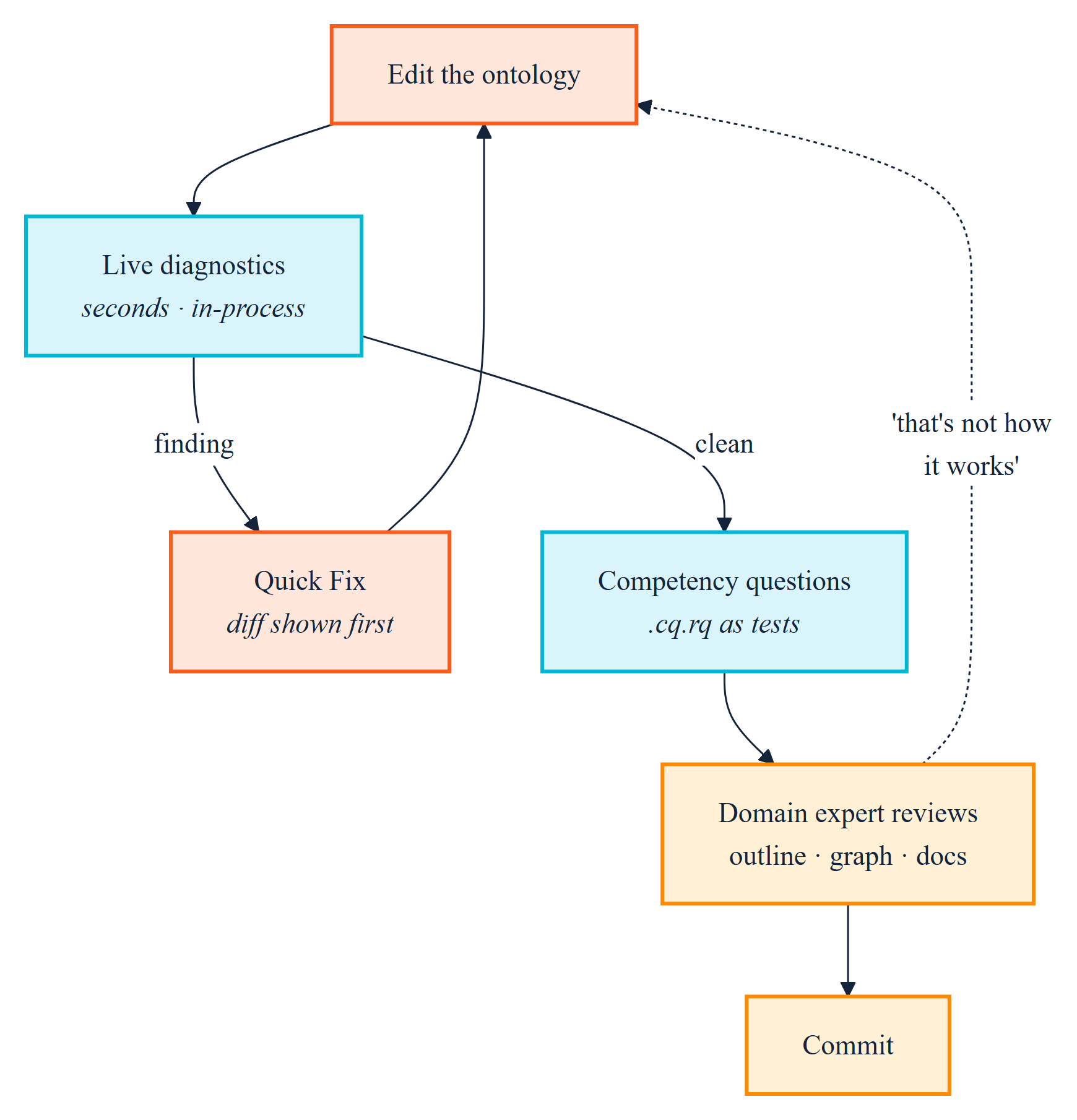
The dotted edge is the one that matters most and is most often missing. A modelling process where the domain expert's correction has no path back into the artefact is the extractive workshop from Chapter 2 wearing a process diagram.
8.6 Maturity checkpoint
Running the commands in this chapter, on a Git-tracked ontology, with the extension installed on engineers' machines, puts a team at maturity Level 2 — Structured Semantic Development: ontologies treated like code, repeatable modelling, early governance, reduced risk of breaking changes.
Level 2 is a decision more than a project. What it does not yet give you is enforcement: nothing here stops someone committing an ontology that fails every check. That is Chapter 9, and it is the transition worth spending real effort on.